Tag: ablism

The Social vs. Medical Model of Disability, Communities Will Be Forced To Choose

Posted by – April 7, 2011

You may or may not know about the medical model and the social model of disability.

Many disabled people have rejected this model. From the Taxi Driver Training -- Democracy, Disability and Society Group, UK

The social model of disability sees disabilities as normal aspects of life, not medical problems requiring "treatment," with the real problems coming from inaccessibility and ignorance of disabled people. From the Taxi Driver Training -- Democracy, Disability and Society Group, UK

I wanted to talk about the social model of services and supports for people with disabilities, and barriers to implementing it.

When you think about disability internationally, most disabled people in countries around the world are taken care of by their own families and their own communities. In Alabama, where I’m from, and in many of the poorer states, they didn’t get the medical model at all until federal funding in the 1960s. Prior to that, all you had was a kind of quasi-social model, with families and neighbors taking care of their disabled children, the same way they did in the 19th century and from time immemorial. A new social model of services and supports would essentially work like an enhanced version of that, with disabilities normal phenomena that communities live with and provide for.

In the first world countries, as families are working almost entirely outside of the home, they have no recourse but to use government services to help take care of their disabled children and adults. In Alabama, the attitude is that the most harsh, spartan medical model is all they can afford, and that they can’t afford to innovate. They have missed an opportunity to save money by re-imagining a social model that would put the power back in the hands of families and people with disabilities, instead of forcing them to spend on treatments that the medical model wants for them.

Across the country, budget cuts are removing the medical model more and more from our lives, because the states can no longer afford the kind of medical services that they’ve been paying for. The medical model won’t be the force it has been without enough public funding. So there’s more need than ever to implement a new social model of services and supports. In one of the conferences that I attended (TASH Boston ‘02) there was a session on what drives people to put their loved ones into nursing homes. And the number one reason found in studies was that when someone becomes incontinent of bladder and bowel, the family doesn’t want to deal with it, and puts them in a facility. There was one story where a mother wanted to put her autistic son in a facility just because he couldn’t figure out how to zipper his pants, though he could otherwise engage in self-care. This is the institutional bias, up close and personal, and it is ridiculous. We can no longer afford to put people with disabilities in segregated, medical model institutions. The funds saved by turning the institutional bias on its head and closing more of these terrible, outdated, freedom-killing institutions is great. We can’t afford these awful dinosaurs financially, and we can’t afford it in the human toll, in the human potential and spirits that are locked up.

To escape that fate of being put away forever in a nursing home, I had to fight Alabama Medicaid policies that would cut off home care services at age 21. My campaign, Nick’s Crusade, led to the Dupree v. Alabama Medicaid lawsuit, which used the Olmstead decision to end the practice of Alabama cutting off ventilator dependent people from in-home services once they turned 21. It was a victory that helped half a dozen people stay in their homes, but it didn’t solve the underlying problem, that even in the home, the medical model of home nursing care tends to segregate, restrict and limit the liberty and potential of people with disabilities.

I ended up having to leave college because of problems with home nursing care, and eventually I began to outlive my family’s ability to take care of me, and ended up relocating to New York City in August, 2008. Because of difficulties getting home care approved and started, home nursing agencies that are dysfunctional and cruel, and relentless ablism faced by me and my partner Alejandra, my first 378 days in New York were spent in a city rehab hospital. It was my first stent in a facility, and I learned a lot about the system that keeps unnecessary institutionalization going and told the world in The First Video Blog Series From Inside An Institution In History. Make especially sure to watch my videos What Life In An Institution Is Really Like, And Why This Entire Model Should Be Replaced and Too Many Setbacks To Count (about the barriers and delays to getting home, with music).

Because Alejandra and I love each other, we made the decision to spend our lives together, as many people with and without disabilities do. However, most people with disabilities living in the U.S. run into the so-called “marriage penalty” if they receive federal Social Security benefits, which are reduced by one-third if two recipients marry. Choosing to declare our commitment to each other despite this policy, we held a commitment ceremony in Central Park on June 6, 2010. It was also an opportunity for others in the community to learn about and share their experiences with this injustice.

Getting the supports needed to maintain my health and safety, attain freedom to access the community and resume college remain problematic. I write and draw webcomics, such as Theodore Roosevelt and the Rough Riders vs. Zombies. I was going to show my work from a table at the MoCCA Festival, and ended up canceling because we didn’t have the help for getting me up in the chair and out to the festival. For me as a disabled man, “freedom,” means that I have good caregivers around me that can help me do stuff. Without those people, I’m stuck in my room at best, and, at worst, dead.

Nurses, personal care attendants, and other home caregivers will always remain enormously important in any model because in first world countries the cost of living is high, and thus the people doing the bulk of the care will be the ones who can do it without losing their apartment. Paid supports should be budgeted by the disabled person (see individualized budgets and the Cash & Counseling program) so that both the caregivers and the patient aren’t constantly battling middlemen–agencies and Medicaid, and so the patient can give their best staff higher pay and bonuses. This essay isn’t meant diminish the importance of nurses and PCAs but to re-imagine them as part of a support community that form around people with disabilities; with families and communities that refuse to shelve their people in prison-like nursing facilities, that refuse to use a strict, heartless medical model inside the home, that say NO to materialism and profiteering, and instead focus on care and caring. Personal care is incredibly intimate and sensitive, caregivers see and touch and care for wounds, deformities and vulnerabilities that no one else sees, this is soulful and special work; it should never be callously commodified or turned into a cold assembly line in a nursing facility. The people who are good at going into someone’s home and making them clean, comfortable, giving them care and freedom, are very special people. In a new social model, friends and neighbors of the disabled person partner with and lend their support to these special caregivers, helping them and assisting them to assist their patient. The caregivers in turn helping the friends to help their patient. They care about each other and collaborate to help the disabled person. The community loves and supports each other.

Relying on Medicaid to give me ALL the assistance needed to live a real life in the community will always be difficult as long as Medicaid is locked-in to the medical model. It’s near impossible without friends and volunteers in your community lending some support. What is needed is the social model: normalization of disability: for society at large to start seeing people with disabilities as equal members of families and communities, instead of undue burdens. If someone in the community had cared about the kid who couldn’t manage the zipper on his pants, he wouldn’t have been at risk of institutionalization at great cost to his community. If the community would give their time and love more, we’d need Medicaid, the increasingly dark, Kafkaesque bureaucracy that pays for services for disabled people, less.

There are plenty of ways for the community to support people with disabilities. When I was hospitalized for several months in early 1992, Bettie Hudgens, the founder of the Communications department at Spring Hill College, where my mom taught, created a sign up sheet so that volunteers would visit me every day, so I would have someone checking in on me during the hours mom was teaching. The signup sheet allowed the community to organize around me so that every day was covered. We need that kind of community building now more than ever.

Communities will eventually be forced to choose, will they pay more and more for Medicaid as its red tape continues to render it hilariously dysfunctional like a Soviet department, or will friends and neighbors pitch in to help the elderly get in and out of bed, and change soiled clothes so they wouldn’t have to be segregated in institutions, so their people with disabilities will have less involvement with the heartless Medicaid bureaucracy and be less exposed to the whims of the politicians that fund them. It’s up to us to implement a new social model, as the old models begin to collapse.

Nick

Share

Rain Man (1988) and Hollywood’s treatment of disability

Posted by – February 5, 2011

Hollywood Images of Disability (CHF EDIT) from salome chasnoff on Vimeo.

Everyone interested in disability rights should watch this 18min short “Hollywood Images of Disability,” about Hollywood’s terrible treatment of disability, which is normally depicted as something so deformed, so unspeakably terrifying that disabled characters have to be cured (Heidi, Monkey Shines, Avatar, and zillions of movies) put away forever (Rain Man) or euthanized (Of Mice and Men, Million Dollar Baby and countless other examples). Note: this short comments on clips from many different movies with R and PG-13 ratings, many of which contain sensationalist depictions of people with disabilities, exaggerated vulnerability of disabled women–Uma Thurmond playing a naked blind woman being vulnerable and threatened, extreme violence and murders of people with disabilities, male and female, and will be disturbing for anyone with a conscience.

I saw Rain Man (1988) on the big screen when it came out (I was 6 years old and I didn’t understand much beyond the beautiful imagery). When I saw it again as a young teenager it impacted me a lot. I really remember it vividly.

Rain Man is the autistic brother that was just discovered by cool dude Charlie (Tom Cruise, who back in the 80s, we all worshiped as the coolest guy ever and wanted to emulate, along with Michael J. Fox & Matthew Broderick–in 1990 I once made mom’s hairdresser make my hair like Michael J. Fox’s). Charlie removes Rain Man/Raymond from the nursing home and they go on an amazing adventure that as a teen I could only dream of. Ray is loosed from his cage! While most men in the audience are undoubtedly identifying with Charlie, the cool as ice, young business shark of the ’80s (see Gordon Gekko) and his struggles and interests, I’m identifying with Ray, and strongly. For the first time, Ray can move around and develop out in the real world: he’s experiencing life with all its thrills, very real dangers, wonderful strangeness, opportunities, fulfillment and sexual excitement. He gets to fail at driving the old Buick convertible, win fat stacks of cash at a beautiful Las Vegas casino. He’s able to really live, warts and all, unlike the nursing home where there is nothing but soulless routine and the dictatorial control of the facility’s staff who don’t really know or care for Ray.

The scene that caught my attention the most was when Ray ends up alone in the casino elevator with a beautiful woman, Charlie’s girlfriend Susanna (Valeria Golino) who brakes the elevator and slow dances with him and kisses him. It is brief but an electrifyingly sexy moment. I’ll go into a great amount of detail so ya’ll can understand how a young disabled man saw these images. They used every camera and make-up trick to make the actress look like the perfect hot date of the 80s style. In this elevator Ray is confronted with a very powerful woman, empowered, living life; she dances with and kisses Ray maybe out of curiosity, maybe because it feels enormously powerful to initiate a man into the world of women. She is open to being inclusive. Possible T-Shirt: NOT A SLUT. INCLUSIVE. When you’re a young disabled man, you see her in the elevator and look at her like a vision of feminine power and inclusivity, a chance at entering the adult world. Not long into the scene, she restarts the elevator, looking a little sad and disappointed that Ray didn’t really kiss her back and touch her, and the moment was over. I was transfixed (nearly every male probably was–it immerses the audience in the ultimate fantasy of a woman actually wanting them).

This was the first time in my life that I had seen a woman interested in giving that kind of attention and affection to a disabled man. It was like a fairy tale come true, Ray doesn’t have to be locked up in the gilded cage at the nursing home, he had a real CHANCE at life, opportunities to see and do amazing things and feel and love. To me, the opportunities to succeed were as important and thrilling, if not moreso, than actually success. At the time, 1994, I was entering puberty and very focused on all these issues, while living in an environment with the myriad barriers so common to the disability experience, plus being guarding by nurses 24/7 had already cut me off from girls, from kids my age entirely in middle school. This movie made me think I could one day escape the cage and talk to women in elevators.

But the movie closed with Tom Cruise putting Ray back in the cage, portrayed as the right thing, the courageous and hard thing to put him back in the nursing home, the more “appropriate” setting. How well Ray did in the real world evidently didn’t matter; he had 1 autistic meltdown (ONE) and accidentally broke the precious coffee maker, and that was the end of that. Charlie is depicted as a hero for doing this and ending Ray’s opportunities for a life, forever. It’s all about Charlie’s journey, the familiar Quest o’ Redemption trope that is as old as literature itself, and in the United States typically involve a journey by car across the American continent. Ultimately, as the short film “Hollywood Images of Disability” illustrates quite well, disabled characters in Rain Man and other Hollywood movies aren’t people as much as Oscar bait for a “difficult” portrayal (for the Raymond role, Dustin Hoffman won the Oscar for Best Actor; “The diseased/addicted/mentally impaired always get the Oscar.” — Hollywood Rule Book, Vanity Fair) and disabled characters are mainly used as plot devices to facilitate the hero’s development. In Rain Man, Ray, his struggles, his interests, aren’t considered at all; the point of the story is that Charlie starts off as a soulless corporate raider, grows to love Raymond, and at the end has evolved into a sensitive, mature adult able to make the “right” “mature” choices in life and love, and, grotesquely, the “mature” choice is to have the lawyer transfer custody of Raymond permanently to the nursing home. I thought it was particularly cruel to show Ray the world only to yank it away. To be expected, in a society where we aren’t wanted and barely accommodated enough to survive, but still a harsh introduction to reality for young teenaged Nick.

Read about the all-too-common “Bury Your Disabled” trope in popular culture, and try to raise awareness that it, along with other disability tropes that are harmful (and/or just ABSURD), are actually really wrong and awful, and should go away….

Nick

Share

This Is All You Need To Know About This Year’s MDA Telethon

Posted by – September 6, 2010

Lots of people are, as always, posting about the MDA Telethon this Labor Day weekend (I recommend this piece by Laura Hershey). Usually the focus is on smashing the negative images (pity) that the MDA Telethon often conveys, and that is crucial because the Telethon brings to all corners of the U.S. the most-watched images of disability all year. But I usually focus on the help the MDA does and doesn’t provide, and how misleading the Telethon is about what they do for us “Jerry’s Kids.”

Jerry Lewis has taken a lot of heat for years over comments like “My kids cannot go into the workplace. There’s nothing they can do.” But I’m more concerned with WHY we can’t get into the workplace than with the negative comment itself. We stay at over double the general population’s unemployment rate not just because of “attitudinal barriers” (pity, seeing us as “less than,” and as charity cases, views the Telethon definitely perpetuates) but because we so often don’t have access to education, transportation, and the assistive technology that we need to succeed. Like wheelchairs.

The MDA sent out a letter to recipients last Fall, notifying us of major nationwide changes for fiscal year 2010: they will no longer help buy wheelchairs for “Jerry’s Kids.”

page 1 of scanned Letter from the MDA

page 2 of scanned Letter from the MDA
This scanned letter, passed to me by a concerned mom of kids with Duchenne’s, is not publicly available on the MDA web site, nor mentioned during the Telethon. I can only hope they don’t continue saying they provide wheelchairs on the Telethon.

The needs of those with MD are being met less and less by the MDA, and less and less by the state, cutting back brutally now thanks to the Great Recession. Now, future “Jerry’s Kids” will never again get a wheelchair with help from the MDA. Please look at these posts from the MDA forums about the changes, and MDA’s response.

I get no help whatsoever from the MDA, no matter how hard I have tried to work with them. The NYU MDA clinic essentially turned me away this year, the clinic director telling me “we don’t do metabolic disease” (nevermind that it was the Mobile, AL MDA clinic that diagnosed me with mitochondrial myopathy when I was a small child, and that their national goodwill ambassador Mattie Stepanek had it). Then, in a classy move, they referred me to a nonexistent “metabolic clinic” that when we called, said there is no such clinic. I’m totally open to discussion with MDA if they want to make this right, I would meet with an MDA representative if given the chance; but I’m not optimistic; their emphasis is simply NOT on those of us who’ve managed to survive into adulthood.

The charity model isn’t all bad; it can make a big difference in the lives of people with disabilities. Just look at the Islamic world, where people with disabilities often are getting more help (both physical and monetary) from their mosque than what we get from Medicaid! I got my first wheelchair from New Orleans MDA. But the MDA is really no longer a service charity, it’s research research research, cure cure cure, cures we’re told on the Telethon are only 5-10 years away but 20 years later are nowhere to be found.

A real charitable organization could make a huge difference in our lives, filling the enormous gaps we fall into every day, an understanding voice that could give hope for better quality of life after yet another Medicaid rejection of services. These diseases are no easy path. I REALLY NEED THE HELP! Just a shoulder to lean on and a little coordination would go a long way. But MDA is not that charitable organization, and it takes up so much “market space,” no competing nonprofit can gain the traction to provide this desperately needed assistance. That is my beef with the MDA, and I wish the discussion among disability rights circles was more in this direction.

Nick

See also, my blog about last year’s Telethon, focusing on dismantling misleading claims made on the Telethon.

Share

ADAPT Blogswarm, Fall Action 2009

Posted by – October 14, 2009

The ‘swarm has arrived! Bloggers across the globe have united to shine a light on rampant unjust institutionalization and segregation of people with disabilities and ADAPTs Fall Action in Atlanta confronting it!

On Disability Unity

NextStep blog
WE ARE ALL IN THIS TOGETHER

Finding My Way: Journey of an Uppity Intellectual Activist Crip
Human Rights

Whose Planet Is It Anyway?
Supporting Allies

Insights

Sanabitur Anima Mea
Look Closer (my favorite post in the ‘swarm)

Metamorphosis (Bob Kafka)
On the discrimination behind the institutional bias

Documenting The Action

PhilosopherCrip
Atlanta Action Days 1 & 2
Atlanta Action Day 3

The Roving Activist’s Blog
I am excited
Live from Atlanta

Today.com’s Official Disability Rights Blog
Action Day One: Conversations with Self
Action Day 2

Finding My Way: Journey of an Uppity Intellectual Activist Crip
Power is sexy and…

Composite: thoughts on poetics & tech
ADAPT in Atlanta kicking ass, taking names

Comment below to add a post to the ‘swarm!

Share

Blog To End Unjust Institutionalization!

Posted by – October 5, 2009

ADAPT is going back to the heart of the civil rights movement, Atlanta, to demand that the promises made to Georgians (and all Americans) by the Supreme Court in Olmstead v. L.C. and E.W. are kept. Read ADAPT’s page on the action here.

Segregating people with disabilities in institutions solely because they need daily help, especially given the 21st century technology that can assist them and the widespread success of people with disabilities living in the community, is fundamentally unjust, immoral, overly costly, and, according to the Olmstead ruling, illegal under Title II of the ADA.

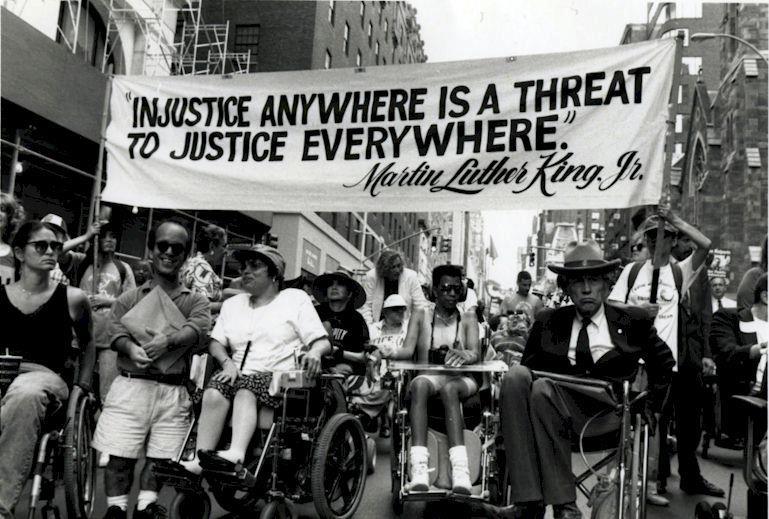
Olmstead, the case of two Georgia natives who wanted the state to stop segregating them, affirmed all Americans’ right to receive care in “the least restrictive setting” (i.e. not in prison-like institutions) and ordered all states to end unnecessary confinement of their disabled citizens (which it deemed illegal discrimination) at a “reasonable pace.” Most states have done little to nothing to comply. The institutional bias of the system is deeply entrenched, and even though the Olmstead decision came down 10 years ago last June, millions of people with disabilities are still kept out of sight, out of mind, stuck in institutions. “A right delayed is a right denied,” Martin Luther King, Jr. would say.


Georgia’s system, the focus of the Olmstead case, remains notoriously bad, insisting on expensive life-long institutionalizations that strip people of any choice in their daily lives, block opportunities to grow and become self sufficient, and kill hope. And most states are similarly awful, especially in the South. They refuse to heed the Supreme Court’s orders, reminiscent of their failure to follow school desegregation rulings “with all deliberate speed.”

We can no longer ignore illegal segregation and the community support services states must use to prevent it. We can no longer ignore Olmstead. We mustn’t put long-term care on the backburner and not include it in this year’s health care reform; telling us to wait another decade or more is deeply unjust. ADAPT will be in Atlanta, October 10-15, demanding that this change. You can help raise awareness around the Fall National Action by blogging!

The ADAPT Blogswarm, Fall ’09, will collect posts raising the issues of the institutional bias, ablist and unjust institutionalization, lack of community-based services, long-term care reform, the Olmstead decision and posts highlighting ADAPT’s Fall Action. Blogswarm posts will all be listed here, on nickscrusade.org, on October 12.

Your blogging is incredibly important to raise awareness of these issues (often swept under the rug). Please contribute to the blogswarm!

For instructions on how to participate, see
ADAPT Blogswarm, Fall Action 2009

Thank you!

Nick

Share

It’s MDA Telethon Time Again!!

Posted by – September 8, 2009

The MDA’s 44th annual Labor Day Telethon was on the TV. Since my family and I were on the local (Mobile, AL) MD Telethon several times, and my mom served a year as Mobile MDA’s president, I thought I should comment.

Many activists attack the MDA for fundraising based on pity. It’s true that their 1950s attitudes about disability can be really grating; the Telethon is decidedly stuck in the past, both in how they see us and their entertainment–it’s always had the kind of acts you would expect to see on The Tonight Show with Johnny Carson; this year’s guests included Tony Orlando, the new Menudo (sans Ricky Martin) and Charo. But what sticks in my craw isn’t that as much as the misleading nature of the Telethon.

That ridiculous caricature of Jerry Lewis, used as a Telethon logo for decades

That ridiculous caricature of Jerry Lewis, used as a Telethon logo for decades

Every year the Telethon gives the impression that the MDA provides significant help for the daily lives of the MD-diagnosed people they’re showing on TV, and most people (even legislators) believe this. But the MDA does not focus on assisting us on the ground, and this is my main beef with them. When I was sick and at death’s door and really needed help, they wouldn’t lift a finger. Chris Wiggins was my oldest friend, and AN MDA POSTER CHILD, and, unfortunately, like so many others in his situation, Medicaid arbitrarily stripped him of the nursing care at age 21. This ultimately led to his death. Despite the fact that Chris and his photo on posters, along with years of tireless work by he and his mom at fundraisers, probably kept the local branch open, when they really needed help, MDA declined. They wouldn’t even help raise awareness of the problem of inadequate home care for “Jerry’s Kids” over 21. Chris, and too many of his compatriots with DMD, died from lack of assistance in the community, of government neglect, not from muscular dystrophy. MDA doesn’t mention that; they focus on research. Many parents with children affected by MD work feverishly to fundraise for the MDA, thinking that when their children inevitably become badly disabled that money they helped raise will assist them in their hour of need. They’re being cruelly misled. MDA doesn’t do that; they focus on research.

Let’s look at some of the misleading claims from this year’s Telethon (from MDA.org):

Telethon claim: MDA provides flu shots to people with MD. “For only $30, you can provide a flu shot for Jerry’s Kids!”.
The truth: Just because national MDA authorizes local branches to cover flu shots, doesn’t mean all do. From what I’ve heard, one guy gets flu shots at an MDA clinic in California, but they aren’t available from Boston MDA. And I don’t know if the reborn Mobile, AL MDA does this, but I never saw the old Mobile MDA offer flu shots (prior to them getting shut down for fraud/embezzlement in 1993).

Telethon claim: MDA provides occupational therapy, physical therapy, and respiratory therapy consultations to people with MD.
The truth: I’m sure some clinics provide this, but I’ve never actually seen it or heard about people receiving this. And remember that if you don’t live near a clinic, you can’t access this, or any MDA services for that matter.

Telethon claim: Thanks to your generous donations all kids with MD can go to MDA summer camp, with no charge to the families!.
The truth: My mom was charged $500 per child. People aren’t barred from camp due to inability to pay, but many local branches directly contradict Telethon promises and bill parents.

Telethon claim: MDA provides wheelchairs for people with MD. On the Telethon, you see shiny new wheelchairs in a row, and all these happy people who got wheelchairs.
The truth: Even for young children they provide little of what is on the Telethon. They will pay up to $2000 toward the purchase of a wheelchair (only if Medicaid and/or private insurance won’t cover all of it) and these days $2k will cover about one tire on a powerchair. And even that small assistance is exceedingly difficult to get. So, needless to say, very few of us get wheelchairs from the MDA. In this annual report on the MDA web site, they brag about giving out the $2k equipment payment (for wheelchairs, crutches, braces, etc.) to 4,200 people in 2008. Think about that. Out of all the millions of MD patients in the U.S., only 4,200 got equipment help last year. There are probably 4000 people with muscular dystrophy in Alabama and Georgia alone who need chairs! The facts on the ground make MDA CEO Bob Ross’ claim that “millions depend on the MDA for their very survival” more than a bit dubious (Ross, who gets $500,000 a year salary from the MDA, “depends” on them way more than most MD patients!)

Jerry Lewis in front of the tote board at the 2007 Telethon

Jerry Lewis in front of the tote board at the 2007 Telethon

The truth is that most of MDA’s efforts aren’t immediately seen by its consumers, as their focus is research to find a cure, laboratory work that we may or may not benefit from decades down the line. The lion’s share of the roughly $1.5 billion the Telethon has raised since its inception has been put toward research, and they’ve become the largest non-governmental sponsor of muscular dystrophy research in the world.

Right now we are in a situation where the public thinks the MDA is covering much more than they actually are, and that can sometimes even complicate efforts to get public sector assistance. When I was in Montgomery arguing against Medicaid’s 21-cutoff, a state senator said, “doesn’t the MDA cover that?” He was baffled and incredulous when told no.

The MDA could change its misleading ways by a) changing their policies and widely providing the goods and services advertised on the Telethon. OR b) stop misleading the audience that they are providing goods and services to us. Just come out and say, “we mainly do research, here are some research projects we are doing.” They could interview researchers and do a lot with the truth. I think it’d be cool to learn about MDA-funded scientific breakthroughs and what they mean. Show us illustrations of how dystrophin works, a diagram of a mitochondrion! Be honest and you’ll go far.

I wouldn’t mind the Telethon as much if they practiced what they preach or preached what they actually practiced. I want the MDA to reform, but I’m not holding my breath.

Nick

Related Bloggery:
Scott Sands Alive: Begging For Charity
Danny Kodmur’s story of the UCP Telethon, and how it improved

Share

NYC’s 19th Anniversary of the Americans with Disabilities Act (ADA) Event

Posted by – August 2, 2009

Nadina LaSpina (NYC ADAPT) gives a powerful, stirring speech about how far disability rights has yet to go, and Elaine Kolb sings an insightful song about the medical-institutional complex at the 19th ADA Anniversary Event in Central Park, July 26, 2009.

Share

Leviticus and Disability: My Take

Posted by – May 7, 2009

Patrick A from PunkTorah asked me to comment on parsha Emor, and here’s what I came up with. I hope the atheists don’t ream me too hard.

Everyone please turn to Leviticus 21, kthx. In this week’s parsha, Emor, Moshe Rabbeinu tells us about some of the laws regulating kohanim (Temple priests).

After the admonition for kohanim to not have contact with corpses, it lists the various deformities and disabilities that would disqualify a kohen from performing his Temple duties. They include: blindness, mobility impairment, sunken nose, unibrow, broken or twisted limb, one limb disproportionate to the other, sores, and, of course, crushed testicles. If the Temple was excluding disabled priests, does that mean Judaism (c”v”s) is discriminatory and ablist?

Josh over at parshablog says one possibility is that this is a concession to the prevailing cultural attitudes of the time. DovBear suggests that this is just one of several “rules and requirements and presumptions that no longer fit anyone’s idea of morality” in Torah.

I don’t fully agree with either of these opinions. I think there’s nothing we can’t learn from, especially words of Torah (nothing is not relevant, and if you’re not able to find something to learn from in a chapter, you’re not looking hard enough). What can we learn from this? Well, to me, ablism means blocking people with disabilities from doing things we can do, assuming we have nothing to contribute, and stifling our potential. It doesn’t mean I get an equal shot of playing shortstop for the Yankees. Maybe a disabled kohen can’t drag a bull up the ramp to the sacrificial altar. And we have to remember that Torah was recorded during a time where G-d was smiting people as an example that even minor infractions should not be committed with the Temple service. This was a lot more important than a Yankee game, and if you were reckless in the Temple, G-d would be reckless with us (ie. smiting). In Torah, every tribe and every person has a role they’re born for, and that’s one lesson we can take away. And in this life of confusion, chaos and darkness, one who finds their purpose, their meaning, is fortunate indeed.

I’m not offended by the stringent requirements for kohanim. Disabled kohanim were never stripped of their title, and were still allowed to eat from the holiest of sacrifices (they got all the benefits of their role). Some were even allowed to perform the priestly blessing (source).

Leonard Nimoy made the Vulcan salute identical to the birkat kohanim (priests blessing) except that the benediction is done with both hands, horizontally, to resemble the Hebrew letter Shin.  For more on this, Nimoys inspiration for the Vulcan salute, see this article on TrekJews.com.

Leonard Nimoy made the "Vulcan salute" identical to the birkat kohanim (priests' blessing) except that the benediction is done with both hands, horizontally, to resemble the Hebrew letter "Shin." For more on this, Nimoy's inspiration for the Vulcan salute, see this article on TrekJews.com.


And unlike illegitimate kohanim, disabled kohanim continued to keep all the benefits, and all the priestly laws. To suggest a physical defect is a spiritual defect (as this commenter did) is ablist and false.

Also in Leviticus, those with skin disease never have to pay for their affliction (free health care). The Torah makes sure that anyone in need is looked after and cared for. Kohanim were responsible for properly caring for and overseeing infection control for the community.

People with disabilities are never excluded or discriminated against in the Torah. Isaac‘s blindness certainly never diminished his authority as a Patriarch and leader.

In this 1638 oil painting by Govert Flinck, a blind and aged Isaac blesses Jacob to be the next leader of Israel

In this 1638 oil painting by Govert Flinck, a blind and aged Isaac blesses Jacob to be the next leader of Israel

I see Torah as proposing a semi-Utopian system, where everyone matters, everyone has a role, everyone has a portion, not the cruel dystopia many paint it as.

Nick

Here is the PunkTorah commentary on this blog. And check out the video:

And to see all the PunkTorah videos, go to the PunkTorah YouTube Channel.

Share

Ablism: Idiotic Comments From Idiots

Posted by – May 2, 2009

This post is for Blogging Against Disablism Day, BADD, 2009.

Blogging Against Disablism Day, May 1st 2009

As I noted here, ablism (discrimination based on ability) is one of the dumber forms of injustice.

It’s dumb because it’s based on falsehoods. Just because someone is in a wheelchair, doesn’t mean they’re deaf or have mental retardation. That man in a wheelchair you just (loudly) talked down to? Maybe that was genius astrophysicist Stephen Hawking, or one of the most talented computer programmers in your city. FAIL. You never know the amazing things people with disabilities are capable of, especially now that rapidly-advancing computer technology and the internet is increasingly leveling the playing field. Despite our abilities and achievements, we are too often condescended to, and treated as outsiders and lesser beings. What a waste.

Personally, I was able to enter college at age 16. Still, I am too often assumed mentally impaired, not taken seriously, or, most angering for me, am openly disbelieved by some of the hospital staff. This is where stupidity crosses the line from annoying to dangerous. “The feeding tube is leaking!” “No it isn’t.” “Yes it is.” “No it isn’t.” And when they discover the bed is wet from the leaking tube and they have to change the pads, my prior warning doesn’t even warrant mention, much less an apology.

My girlfriend (the amazing, the wonderful, the beautiful) blogs here about hospital ablism, people not taking me seriously, and one incident where a hospital administrator told her that allowing her to stay late to help me would be pointless because she’s disabled. Paradoxically, those who deal with disability professionally (those in hospitals, nursing agencies, etc.) are often the rudest, most anti-disability people you’ll meet, much worse than random people off the street or at work or school.

And now for rank idiocy! sorry to digress into silly season here, but I can’t let Blogging Against Disablism Day go by without posting the footage of Glenn Beck recently mocking Obama’s aunt’s disability (warning: contains extreme, brain-boiling stupidity). He’s essentially an 8th grade class clown, and here he’s mocking Obama’s aunt’s limp, and, more broadly, making fun of anyone sympathizing with people with disabilities. Ha ha, only a weak-kneed bleeding heart wussy would hesitate to deport a disabled person to Africa where nothing’s accessible!

Glenn Beck is stupid.

Glenn Beck is stupid.

Glenn Beck is an idiot.

Society needs less ablist idiocy, not more.

Nick

Share

Government-Sponsored Ablism and Segregation Tears Families Apart

Posted by – May 1, 2009

This post is for Blogging Against Disablism Day, BADD, 2009.

Blogging Against Disablism Day, May 1st 2009

There’s a dark part of America’s past (and present) that few are aware of: government taking children from their families and placing them in institutions.

It usually goes like this: doctors and social workers identify a disabled child, and advise the parents to send the child to an institution to get “the best of care,” from “the experts” and “be with kids like them.” Sometimes they’d recommend parents “move on with your lives.” In some cases, most of them decades ago, children were made wards of the state and whisked away from their families, for “their own good.” We’re talking about young kids here, 5-10 years old, many of which had mild disabilities, perhaps CP, MR or autism, not needing intensive supports at all.

That’s where the ablism comes in. Just because these children are different, or need some help, they’re assumed to need locking up in institutions. The doctors and social workers aren’t aware that “the experts” they’re letting raise these kids are the nurses and aides most likely to resent disability and the needs it involves (more work for them) and most likely to brutally restrict and control kids (to avert any possibility of trouble or more work for them). That means the kids will be horribly stunted: boys will never able to touch a girl’s hair, girls never able to “play doctor” with the boy across the street, and no one able to sneak an extra cookie (each meal is strictly controlled). And if they find a way to do these anyway, their reaching of these developmental milestones will be demonized; they’ll learn to hate their humanity, hate the needs and trouble their disabilities cause the staff.  They grow up in what’s essentially a special type of prison, where the natural experimentation crucial for human growth is banned. Not only are they segregated physically, they’re segregated from normal human contact, from basic experiences, from growth, from life.  While I wasn’t raised in an institution, I was exposed to this mentality, plenty. Special ed aides would grab my manual wheelchair and pull against me spinning the wheels, to prevent me from straying from them (and interacting with other children) during recess, to ensure my “safety.”

••••

Each afternoon, at the city rehab hospital I live in, a yellow school bus pulls up out front. The bus is dropping off the institutionalized children who live here. You can’t help but wonder, “what will these children grow up to become?”  In my experience, from meeting those who moved to the community after the local institution (or “developmental center”) closed following the landmark 30-year-long Wyatt v. Stickney desegregation lawsuit, is that you can take the person out of the institution, but you can’t take the institution out of the person; their mind will, to an extent, forever be institutionalized.  They will never question authority figures, or take actions without the consent of an authority figure.  Some who got out are leading successful lives, with jobs and many things they could’ve never had in an institution (a great argument why more deinstitutionalization needs to happen NOW) but decades of success were robbed from them.  Their development was stunted, their independence has been stripped, and their mild mental differences became serious impairments, now requiring aides (they should maybe rename “developmental centers” “regression centers.”) It’s how they were trained, to be dependent.

America has set up this enormous infrastructure of segregation for people with disabilities, and it’s wrong. Why do we do this? It’s rooted in outdated, ablist ideas.  Institutionalization began in earnest in the 19th century, and picked up and expanded widely with the technology of the 20th century.  It was based on the false notions of that era, like the need to isolate the disabled in institutions far from the community in order to keep contagions at bay, put the vulnerable under care of “experts,” and the theory that “they’ll be happier around their own kind.”  The deeply-ingrained concept that “you’re different, therefore you should be segregated” is the pinnacle of bigoted ablist thinking, and it’s the underpinning of all this stuff.  And even with all these theories disproven, too many old institutions remain, sustained by inertia, special interest groups, and the lack of community-based alternatives.

It’s hard for me to blame the parents for consenting to send their kids to this fate when there are few, if any, community-based options to turn to. With little support, and confusion about what to do, it’s not surprising widespread institutionalization has happened. The state forces parents into a grim Faustian Bargain of necessity, something way too close to The Kinder Transport for America, forced to choose between sending children away, or leave them to some uncertain, horrible fate trying to raise them with no supports, no safety net.

Some families are now trying to find children lost to the gulags decades ago.

Kevin Hopkins holds a photo of his lost sister, from <em/>People Magazine

People magazine: Kevin Hopkins holds a photo of his lost sister

From People magazine:

(Newstands only; article not available on the magazine’s website.)

Families across the country are searching for loved ones with disabilities who were sent away to institutions years ago, often without warning or explanation.

Kevin Hopkins, 53, of Springfield, Virginia, is seeking his stepsister Janet, who was sent to an institution 42 years ago. “She was my best friend,” he said. “I just wish I could know where she was and see her again.”

Shawna Gagnon, 49, of Montgomery, Alabama said her sister Zena (Xena) was taken to a California hospital 43 years ago “where people hollered and were tied to the beds.”

Filmmaker Jeff Daly, creator of the documentary “Where’s Molly?”, has been working to find family links for the estimated 250,000 Americans who live in group homes or state institutions with no family contacts. He and the nonprofit ArcLink have built a relative search database that has already fostered more than 100 reunions.

Source: PatriciaEBauer.com: The Endlless Search

More institutions are closing under mounting allegations of human rights violations, but we need the community resources to make these outdated ablist models obsolete forever.  It’s obvious that the best environment for children is a natural family setting, but too many families are STILL forced to choose institutions, especially in the South (like my old home state of Alabama) where there are few community-based options to turn to.  The best thing for the child, would be to fund attendants from the community to assist the family in caring for the child in the home.  But home and community-based services (HCBS) are purely optional for state Medicaid agencies, not a mandated service under Medicaid law.  Meanwhile, it’s mandatory to fund the huge institutions that cost much more (often double or triple the expense) and (almost inevitably) neglect, set back and stifle human growth and potential.  The harsh inhumanity involved, demands change.  We are complicit in our government’s policies, and must demand better.  It’s time for the Community Choice Act, which would make providing home care mandatory for Medicaid too, and give people a real choice.  LET MY PEOPLE GO!!!

LET MY PEOPLE GO!! on silk, from jewishbazaar.com

"LET MY PEOPLE GO!!" on silk, from jewishbazaar.com

A CCA Banner, from Mark Boatmans Blog

A CCA Banner, from Mark Boatman's Blog

An ADAPT activist holds an Our Homes NOT Nursing Homes sign, at the DUH City Action, September 2008

An ADAPT activist holds an "Our Homes NOT Nursing Homes" sign, at the "DUH City" Action, September 2008

Nick

Related Posts with Thumbnails
Share