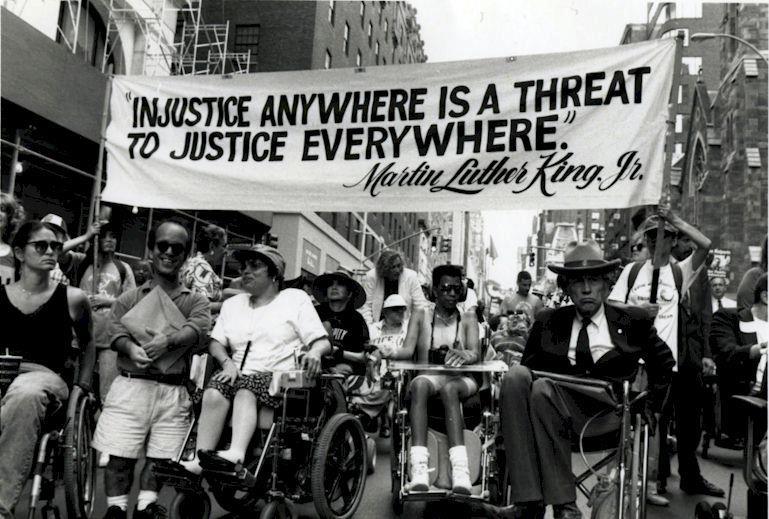
The ’swarm has arrived! Bloggers across the globe have united to shine a light on rampant unjust institutionalization and segregation of people with disabilities and ADAPTs Fall Action in Atlanta confronting it!
ADAPT is going back to the heart of the civil rights movement, Atlanta, to demand that the promises made to Georgians (and all Americans) by the Supreme Court in Olmstead v. L.C. and E.W. are kept. Read ADAPT’s page on the action here.
Segregating people with disabilities in institutions solely because they need daily help, especially given the 21st century technology that can assist them and the widespread success of people with disabilities living in the community, is fundamentally unjust, immoral, overly costly, and, according to the Olmstead ruling, illegal under Title II of the ADA.
Olmstead, the case of two Georgia natives who wanted the state to stop segregating them, affirmed all Americans’ right to receive care in “the least restrictive setting” (i.e. not in prison-like institutions) and ordered all states to end unnecessary confinement of their disabled citizens (which it deemed illegal discrimination) at a “reasonable pace.” Most states have done little to nothing to comply. The institutional bias of the system is deeply entrenched, and even though the Olmstead decision came down 10 years ago last June, millions of people with disabilities are still kept out of sight, out of mind, stuck in institutions. “A right delayed is a right denied,” Martin Luther King, Jr. would say.
Georgia’s system, the focus of the Olmstead case, remains notoriously bad, insisting on expensive life-long institutionalizations that strip people of any choice in their daily lives, block opportunities to grow and become self sufficient, and kill hope. And most states are similarly awful, especially in the South. They refuse to heed the Supreme Court’s orders, reminiscent of their failure to follow school desegregation rulings “with all deliberate speed.”
We can no longer ignore illegal segregation and the community support services states must use to prevent it. We can no longer ignore Olmstead. We mustn’t put long-term care on the backburner and not include it in this year’s health care reform; telling us to wait another decade or more is deeply unjust. ADAPT will be in Atlanta, October 10-15, demanding that this change. You can help raise awareness around the Fall National Action by blogging!
The ADAPT Blogswarm, Fall ‘09, will collect posts raising the issues of the institutional bias, ablist and unjust institutionalization, lack of community-based services, long-term care reform, the Olmstead decision and posts highlighting ADAPT’s Fall Action. Blogswarm posts will all be listed here, on nickscrusade.org, on October 12.
Your blogging is incredibly important to raise awareness of these issues (often swept under the rug). Please contribute to the blogswarm!
Obama Administration Signs the CRPD Treaty, But Is In Flagrant Violation Of It, The ADA, Olmstead, and Its Own “Year of Community Living” PR Campaign, As Arbitrary Termination of Medicaid Home Care Services at Age 21 Continues Unabated
The recent addition of the U.S. as a signatory to the UN Convention on the Rights of People with Disabilities (CRPD) has been much ballyhooed. Any idea if/when Article 19 of the CRPD Treaty will be enforced? That’s the article that guarantees me community choice, the freedom to live in my community, without fear of being segregated in a nursing home because the government will only provide care in institutions. You know, the right to “the most integrated setting” that TEN YEARS AGO the Supreme Court ruled we’re entitled to under the ADA?! This is particularly bitter for me because I am currently STUCK IN AN INSTITUTION. Why agree to Article 19 when we are not following it?! The feds continue to look the other way while poorer states cut off community services for the severely disabled just because they’ve turned 21, and leave them no choices but death and/or an institution. I had to fight that policy years ago in Alabama, and won, but apparently this despicable practice is still going strong in Illinois, as I recently read on VentWorld:
My son turns 21 at the end of August and will lose his current funding source. There are no adult waivers or funding that would provide him with the same level of support he has now. Trying to get info to prove that he would NOT be safe in a skilled nursing facility or nursing home. I found a web site where I can look up the name of a home to find out their staffing levels, ratios, violations, etc. but I have to know the name of the homes first. When I do search for homes the results are not specific to ones that can handle complex ventilator care. The state of Illinois wants the cheapest plan for my son which means without proper documentation they will only provide him with minimal funding for nursing care in our home. He currently has 114 hours per week and 336 respite care hours per year. The state is saying the adult program only allows for about 30-40 hours per week – more if we use non-skilled people. The state wants to find the cheapest way to care for him and if that is a nursing home then I must have proof that the staffing ratios will not be adequate for him. Plus there are no facilities anywhere close to where we live so he would have to leave his community, his friends, his family, his job, etc. He is very social, wants to continue living at home and just because he has a birthday his life is being turned upside down. If you know of facilities that take patients 21 years of age or older with complex ventilator care and what level of staff and their ratios please respond. Thank you.
I’ve been fuming furious ever since I found this post a few days ago; despite all my years of work on the 21 “aging out” policies, despite the fact that I brought national attention to the problem and forced the HHS secretary to notice, the government (state AND federal) are still allowing this unintended consequence of the EPSDT program to put even ventilator-dependent people and their families in a horrible, untenable positions where their lives will be torn apart at best, and lost to nursing home neglect at worst. For adults, it’s incredibly difficult to remain at home if you have a severe disability. As Dr. Ford Vox wrote in a recent piece in Salon: “…if your electric wheelchair breaks down or needs a new battery, we’ll have no problem moving you into a nursing home. You’d prefer a new battery so you can continue living at home? You picked the wrong state. As a poor Missourian, you’ll have no more than 30 days for your rehabilitation. Not quite ready to go home? Need a few more days of intensive therapy? Again, you picked the wrong state. Missouri Medicaid wants to admit you to a nursing home so much that it also doesn’t allow for outpatient physical therapy services or in-home therapies, taking another essential tool out of the hands of your medical team.”
We won CRPA, The ADA, Olmstead, and more, but our victories seem almost inversely proportional to the realities on the ground, as states slash services to the bone at the same time as the disabled population (uninsured or uninsurable) grows. The president announced his “Year of Community Living” as a mother in Illinois prepares to move her ventilator-dependent son away from his job and community and into an institution just because he’ll soon turn 21 and “age out” of what little services the feds require state Medicaid agencies provide to children.
The “out of sight, out of mind” mentality of our politicians makes me angry; the fact that so many advocates in the disability community, who should be fighting for our most vulnerable people, are every bit as unaware of the 21 cutoff infuriates me. The termination of Medicaid home care services at 21 is like this wormhole that’s continuing to suck innocent people in and lead them to institutionalization and/or death, and the fact that I’m (as far as I know) still the only activist noticing this and fighting back is intensely frustrating and disturbing. We’ve GOT to stop fiddling while Rome burns, and unite to end the worst injustices. And the ongoing FAILURE to rectify the 21 cutoff situation should certainly be at the top of that list.
Nadina LaSpina (NYC ADAPT) gives a powerful, stirring speech about how far disability rights has yet to go, and Elaine Kolb sings an insightful song about the medical-institutional complex at the 19th ADA Anniversary Event in Central Park, July 26, 2009.
44 years ago, Congress passed several historic amendments to the Social Security Act, the Medicare and Medicaid programs. Back then, there were no home ventilators, there were few medications for managing disease, there were no home Hoyer lifts, and Congress couldn’t imagine the elderly and disabled living at home successfully and independently. The technology and possibilities for independent living have been available for over three decades now, but the law has not changed. The feds only mandate that state Medicaid agencies cover long-term care in nursing homes and other institutions. Basically, Pharaoh will only allow you care in a prison-like setting. People with disabilities are forced every day to leave their taxpaying jobs and families behind to go into these prisons. It’s the only way they can get the care needed to stay alive. “Give up your freedom or give up your life,” is no choice at all.
The Pharaoh is now drafting his plan to reform America’s insane health care system, but has said that long-term care, which Medicaid is the number one provider of, will not be reformed in this package. How can they reform health care without addressing long-term care, one of the biggest expenses straining state budgets and bankrupting American families? It is bizarre that legislators and voters could ever see this as a separate issue, when it is one of the worst examples of how badly the system is broken. Institutions cost the most of any long-term care option, but are enshrined in law as mandatory, while home care services, the least expensive option, are slashed to the bone by states because they are “optional.” States are still forcing people with disabilities into institutions, the most costly option, because of the antiquated and discriminatory institutional bias in federal Medicaid law that both parties continue to choose to ignore.
The Democrats created the institutional bias when they drafted Medicaid law 44 years ago. Now, amidst their push to overhaul the system, they are ignoring calls from activists to rectify this injustice. On Tuesday, ADAPT activists, after months of letters and phone calls did not produce results, visited 25 Democratic offices around the country to demand that meetings be scheduled to hear their concerns, and that the Democrats apologize for 44 years of unjust policies that have stolen billions from taxpayers and stolen millions of productive lives from their communities. Here is a video clip of activists visiting Senator Baucus’ office in Missoula, MT and stating their case. Other activists were camped out at the DNC headquarters in Washington DC, keeping vigil until their demands are finally heard. 44 years is enough of this injustice; it’s time to change.
IT’S TIME.
We all owe ADAPT our support. They are putting themselves on the line, facing arrest, threats, getting carried out of the DNC by police, their accessible portable toilet was confiscated, but they’re still speaking up when no one else will, for those in nursing homes that are not being heard. Pharaoh, LET MY PEOPLE GO!
Full transcript of the video, with links and footnotes:
This is Nick Dupree for the Nick’s Crusade Blog. I’ve now been in the institution for over 8 months now. I came here because there’s a lot more services, a lot more programs here, and a lot more flexibility and opportunities for people with disabilities. But the problem is, we’ve found that even though there are more programs here, bureaucracy makes it hard to get to them. We’ve had so many setbacks that it would take The Count to count them.
“I am The Count. Do you know why they call me the Count? Because I love to count things.” [maniacal laughter] [The Count counts]
First of all, the hospital is not familiar with discharging ventilator patients, because if you’re on a ventilator, this place is a lot like the Hotel California – you check in and you never leave…
“Mirrors on the ceiling,
The pink champagne on ice
She said ‘we are all just prisoners here, of our own device’
In the master’s chambers,
They gathered for the feast
The stab it with their steely knives,
But they just can’t kill the beast
Last thing I remember, I was
Running for the door
I had to find the passage back
To the place I was before
‘relax,’ said the night man,
We are programmed to receive.
You can checkout any time you like,
But you can never leave!”
[guitar solo]
So, because they’re not familiar with the discharge process, it’s been hard for them here at the hospital to get together the paperwork so I can get nursing and go home and have home nursing to support me at home. So what’s happened is, they do it wrong, the Dept. of Health in Albany sends it back and says, no do it again, and then they send it again, and then they say, “no, something’s missing, you need to train the caregiver and document it again, you need to send the documents from the home visit…” so we’ve experienced setback after setback, and it’s costing the government over $1000 a day, but that doesn’t seem to motivate them to expedite this. Hey, it’s not their money, it’s yours!
When people with disabilities are not as able to advocate for themselves or be persistent, they end up stuck for years and years and years unnecessarily institutionalized and watching the world and the people around them enjoying life while they’re stuck in an nursing home. So we’ve had setback after setback, and this week, after we finally got all the paperwork figured out, the nursing agency flaked out on us, so now we have to get another nursing agency. And it’s setback after setback, enough setbacks that The Count would love to count them.
Full transcript of the video, with links and footnotes
This is Nick Dupree for the Nick’s Crusade blog. I’ve been in the institution almost 8 months now; you see the clock tickin’ away. It’s the large hospital ventilator1, large and unnecessary, unlike the one at I had at home2. Here you see the tangle of unnecessary double limb tubes3. And that’s me.
I’m doing this blog because I want people to know what an institution is really like, and why the model is broken and needs to be replaced.
Institutions are usually large and they cost a lot to keep open. Just the cost of electricity for a giant institution will blow your mind. And then you have to pay for all the food, all the staff, the administration, the financial people to handle all the billing… like a small army has to handle the billing. And then, with something so large, there’s not enough money to hire a lot of staff for the patient care, so institutions are always going to be understaffed. You’re always gonna have, you know, 3 or 4 staff to a unit of 20 people, or maybe 2 staff to 20 people. For the nursing home part of the facility here4, you have way less than that, and what happens is you come here as a patient, and what you soon find is that there are not enough staff to go around. The staff have to take care of other patients, so you’re gonna be alone in a room most of the time. And you just hope when you ring the call bell, somebody is close enough to the nurse’s station to actually hear it.
And it’s an environment where things get missed, because there’s not enough staff. The little things that get missed… the quality of life of the patient goes through the basement. You might not be able to eat when you want to eat, because there’s not enough staff. You have to eat when there’s staff there that can help you, and that might only be an hour a day, or whatever. So things get missed. And it’s not that the nurses and the aides are bad, that’s not true at all. I’ve met a lot of good, really good nurses here, really good aides. With very few exceptions, they’re good, but they just don’t have time.
Recently, you’ve read about abuse in institutions, and the solution that the state always comes up with is: let’s increase funding, let’s give more funding for oversight. And ultimately, that’s not going to fix the problem. It’d be like giving a new paint job to a car that has no wheels. The model itself is broken.
No matter how much money you pour into these institutions, it’s not going to fix the underlying problem, and that’s segregation. Institutions segregate people and keep them stuck with no family! And no friends, or friends that have to leave after the visiting hours, and the person is left alone, and that negatively affects their recovery.
For about 17 years, I had nurses in the home setting, one-on-one care5. And when you’re severely disabled, you can’t afford to be in an institution. Although it costs exponentially more than home care, if you’re severely disabled, you can’t afford to be in a nursing home. So the entire model has to go away from outdated nursing homes, and all that money has to go into community services, or the quality of life, and the health outcomes, with infections and everything else, are going to be terrible.
Changing the system is something that this country has to do.
Footnotes
1. The Puritan Bennett 760 ventilator 2. Seems really unnecessary after using the (comparatively) much smaller LP ventilators for 14 years. 3. Seems really unnecessary after using the (comparatively) much simpler single limb circuits on the LP vents for the past 14 years. Note how the tangle of double limb tubes makes it look like I’m being attacked by the Flying Spaghetti Monster. 4. The entirety of C Building and two floors of the A Building are dedicated to the nursing home. The rest of A building are hospital units. I am in a rehab hospital unit in the A Building. 5. I naturally compare my experiences here to my life with one-on-one nursing care back home in Alabama.
It sounds absurd, right? But that’s what’s been happening with institutions that abuse people with disabilities.
First, an example of abuse from my local area:
NEW CITY – Frank Zanghi says his blind, deaf son, who uses a wheelchair, was abused when he lived in a facility for the developmentally disabled in New Jersey years ago. His son’s front tooth was knocked out, his back was slashed and his penis required five stitches.
Now what happened to the monstrous place that subjected a deaf/blind child to such horrible physical and sexual abuse? The perpetrators were jailed? At the very least, was the institution involved shuttered, and the millions of taxpayer dollars supporting it moved elsewhere to non-abusive settings? Nope and no.
The father of the victim wants more funding for the types of places that so severely abused his son.
Zanghi says the abuse happened because of funding cuts to the facility. Now he’s worried that Gov. David Paterson’s proposed budget that reduces funding for the Office of Mental Retardation and Developmental Disabilities will take a severe toll on organizations like Jawonio, where his son, Joseph, has been receiving care for 15 years.
Though Jawonio is not the same culprit in New Jersey that abused Joseph, NO institutions should be receiving financial rewards (increased funding) for the abuse and low quality of life they so often provide us. We should shut down institutions, and put that money into home care and small group homes integrated in our neighborhoods. We should make this transition all the faster when the recession is pressuring states to shed expensive and outdated programs like institutionalization (sadly, states have not been increasing home care to compensate as they close institutions).
Further, although funding cuts definitely hurt quality of life in institutions, increased funding often makes no difference in these hell holes. Last year, the state of Texas poured millions into its state institutions. The result? The night staff at Corpus Christi State School arranged human dogfights, threatening mentally disabled residents with jail unless they fought, and laughing at their terror and betting on the outcomes. ABC News recently brought national attention to this disgusting story (warning: contains disturbing violent videos).
In this disturbing image of the "fight club" at Corpus Christi State School, one resident chokes another, as staff snap pictures with their cell phones.
After seeing this debacle, merely the latest chapter in its long and infamous history of abuse, the state will obviously close the doors on this dangerous environment and move the residents somewhere safer, right? NO!! Texas’ solution? Putting an additional $112 million into their 13 gulags for the mentally disabled! Whenever they abuse people, these institutions get rewarded with more money! Incredibly, this $112 million dollar commitment was enough for federal prosecutors to back down on the numerous civil rights violations they had found, and settle the case. Closing down these places isn’t even on the table; all the thinking is deeply embedded “inside the box.”
“They’ve already dumped lots of money into the system and nothing has really improved,” said Beth Mitchell, Senior Managing Attorney of Advocacy Inc., an organization that works to protect the rights of Texans with disabilities. “It’s sad that we may end up spending a significant amount of money and not see a significant improvement to the system.”
If we actually care about stopping abuse, we have to move to a new, community model. Repainting and refurbishing a car with no wheels won’t get us anywhere.
After becoming a nationally-known with "Nick's Crusade," his successful, two-year campaign to change Medicaid in Alabama, Nick Dupree traveled the country, telling his story and training others to be activists. This blog documents the ongoing pursuit of justice for people with disabilities and all other marginalized groups. Everyone and everything is connected; harm to one is harm to all. Nick was a long-time opinion columnist for his college's newspaper, The Springhillian, and loves bringing readers fresh insights on government, life, history, disability, health care, morality, religion, foreign policy and more.
Nick left college in 2005 and last year moved from the Gulf Coast to New York City, seeking new opportunities.