Category: Health care and Disability Rights

The Social vs. Medical Model of Disability, Communities Will Be Forced To Choose

Posted by – April 7, 2011

You may or may not know about the medical model and the social model of disability.

Many disabled people have rejected this model. From the Taxi Driver Training -- Democracy, Disability and Society Group, UK

The social model of disability sees disabilities as normal aspects of life, not medical problems requiring "treatment," with the real problems coming from inaccessibility and ignorance of disabled people. From the Taxi Driver Training -- Democracy, Disability and Society Group, UK

I wanted to talk about the social model of services and supports for people with disabilities, and barriers to implementing it.

When you think about disability internationally, most disabled people in countries around the world are taken care of by their own families and their own communities. In Alabama, where I’m from, and in many of the poorer states, they didn’t get the medical model at all until federal funding in the 1960s. Prior to that, all you had was a kind of quasi-social model, with families and neighbors taking care of their disabled children, the same way they did in the 19th century and from time immemorial. A new social model of services and supports would essentially work like an enhanced version of that, with disabilities normal phenomena that communities live with and provide for.

In the first world countries, as families are working almost entirely outside of the home, they have no recourse but to use government services to help take care of their disabled children and adults. In Alabama, the attitude is that the most harsh, spartan medical model is all they can afford, and that they can’t afford to innovate. They have missed an opportunity to save money by re-imagining a social model that would put the power back in the hands of families and people with disabilities, instead of forcing them to spend on treatments that the medical model wants for them.

Across the country, budget cuts are removing the medical model more and more from our lives, because the states can no longer afford the kind of medical services that they’ve been paying for. The medical model won’t be the force it has been without enough public funding. So there’s more need than ever to implement a new social model of services and supports. In one of the conferences that I attended (TASH Boston ‘02) there was a session on what drives people to put their loved ones into nursing homes. And the number one reason found in studies was that when someone becomes incontinent of bladder and bowel, the family doesn’t want to deal with it, and puts them in a facility. There was one story where a mother wanted to put her autistic son in a facility just because he couldn’t figure out how to zipper his pants, though he could otherwise engage in self-care. This is the institutional bias, up close and personal, and it is ridiculous. We can no longer afford to put people with disabilities in segregated, medical model institutions. The funds saved by turning the institutional bias on its head and closing more of these terrible, outdated, freedom-killing institutions is great. We can’t afford these awful dinosaurs financially, and we can’t afford it in the human toll, in the human potential and spirits that are locked up.

To escape that fate of being put away forever in a nursing home, I had to fight Alabama Medicaid policies that would cut off home care services at age 21. My campaign, Nick’s Crusade, led to the Dupree v. Alabama Medicaid lawsuit, which used the Olmstead decision to end the practice of Alabama cutting off ventilator dependent people from in-home services once they turned 21. It was a victory that helped half a dozen people stay in their homes, but it didn’t solve the underlying problem, that even in the home, the medical model of home nursing care tends to segregate, restrict and limit the liberty and potential of people with disabilities.

I ended up having to leave college because of problems with home nursing care, and eventually I began to outlive my family’s ability to take care of me, and ended up relocating to New York City in August, 2008. Because of difficulties getting home care approved and started, home nursing agencies that are dysfunctional and cruel, and relentless ablism faced by me and my partner Alejandra, my first 378 days in New York were spent in a city rehab hospital. It was my first stent in a facility, and I learned a lot about the system that keeps unnecessary institutionalization going and told the world in The First Video Blog Series From Inside An Institution In History. Make especially sure to watch my videos What Life In An Institution Is Really Like, And Why This Entire Model Should Be Replaced and Too Many Setbacks To Count (about the barriers and delays to getting home, with music).

Because Alejandra and I love each other, we made the decision to spend our lives together, as many people with and without disabilities do. However, most people with disabilities living in the U.S. run into the so-called “marriage penalty” if they receive federal Social Security benefits, which are reduced by one-third if two recipients marry. Choosing to declare our commitment to each other despite this policy, we held a commitment ceremony in Central Park on June 6, 2010. It was also an opportunity for others in the community to learn about and share their experiences with this injustice.

Getting the supports needed to maintain my health and safety, attain freedom to access the community and resume college remain problematic. I write and draw webcomics, such as Theodore Roosevelt and the Rough Riders vs. Zombies. I was going to show my work from a table at the MoCCA Festival, and ended up canceling because we didn’t have the help for getting me up in the chair and out to the festival. For me as a disabled man, “freedom,” means that I have good caregivers around me that can help me do stuff. Without those people, I’m stuck in my room at best, and, at worst, dead.

Nurses, personal care attendants, and other home caregivers will always remain enormously important in any model because in first world countries the cost of living is high, and thus the people doing the bulk of the care will be the ones who can do it without losing their apartment. Paid supports should be budgeted by the disabled person (see individualized budgets and the Cash & Counseling program) so that both the caregivers and the patient aren’t constantly battling middlemen–agencies and Medicaid, and so the patient can give their best staff higher pay and bonuses. This essay isn’t meant diminish the importance of nurses and PCAs but to re-imagine them as part of a support community that form around people with disabilities; with families and communities that refuse to shelve their people in prison-like nursing facilities, that refuse to use a strict, heartless medical model inside the home, that say NO to materialism and profiteering, and instead focus on care and caring. Personal care is incredibly intimate and sensitive, caregivers see and touch and care for wounds, deformities and vulnerabilities that no one else sees, this is soulful and special work; it should never be callously commodified or turned into a cold assembly line in a nursing facility. The people who are good at going into someone’s home and making them clean, comfortable, giving them care and freedom, are very special people. In a new social model, friends and neighbors of the disabled person partner with and lend their support to these special caregivers, helping them and assisting them to assist their patient. The caregivers in turn helping the friends to help their patient. They care about each other and collaborate to help the disabled person. The community loves and supports each other.

Relying on Medicaid to give me ALL the assistance needed to live a real life in the community will always be difficult as long as Medicaid is locked-in to the medical model. It’s near impossible without friends and volunteers in your community lending some support. What is needed is the social model: normalization of disability: for society at large to start seeing people with disabilities as equal members of families and communities, instead of undue burdens. If someone in the community had cared about the kid who couldn’t manage the zipper on his pants, he wouldn’t have been at risk of institutionalization at great cost to his community. If the community would give their time and love more, we’d need Medicaid, the increasingly dark, Kafkaesque bureaucracy that pays for services for disabled people, less.

There are plenty of ways for the community to support people with disabilities. When I was hospitalized for several months in early 1992, Bettie Hudgens, the founder of the Communications department at Spring Hill College, where my mom taught, created a sign up sheet so that volunteers would visit me every day, so I would have someone checking in on me during the hours mom was teaching. The signup sheet allowed the community to organize around me so that every day was covered. We need that kind of community building now more than ever.

Communities will eventually be forced to choose, will they pay more and more for Medicaid as its red tape continues to render it hilariously dysfunctional like a Soviet department, or will friends and neighbors pitch in to help the elderly get in and out of bed, and change soiled clothes so they wouldn’t have to be segregated in institutions, so their people with disabilities will have less involvement with the heartless Medicaid bureaucracy and be less exposed to the whims of the politicians that fund them. It’s up to us to implement a new social model, as the old models begin to collapse.

Nick

Share

Rain Man (1988) and Hollywood’s treatment of disability

Posted by – February 5, 2011

Hollywood Images of Disability (CHF EDIT) from salome chasnoff on Vimeo.

Everyone interested in disability rights should watch this 18min short “Hollywood Images of Disability,” about Hollywood’s terrible treatment of disability, which is normally depicted as something so deformed, so unspeakably terrifying that disabled characters have to be cured (Heidi, Monkey Shines, Avatar, and zillions of movies) put away forever (Rain Man) or euthanized (Of Mice and Men, Million Dollar Baby and countless other examples). Note: this short comments on clips from many different movies with R and PG-13 ratings, many of which contain sensationalist depictions of people with disabilities, exaggerated vulnerability of disabled women–Uma Thurmond playing a naked blind woman being vulnerable and threatened, extreme violence and murders of people with disabilities, male and female, and will be disturbing for anyone with a conscience.

I saw Rain Man (1988) on the big screen when it came out (I was 6 years old and I didn’t understand much beyond the beautiful imagery). When I saw it again as a young teenager it impacted me a lot. I really remember it vividly.

Rain Man is the autistic brother that was just discovered by cool dude Charlie (Tom Cruise, who back in the 80s, we all worshiped as the coolest guy ever and wanted to emulate, along with Michael J. Fox & Matthew Broderick–in 1990 I once made mom’s hairdresser make my hair like Michael J. Fox’s). Charlie removes Rain Man/Raymond from the nursing home and they go on an amazing adventure that as a teen I could only dream of. Ray is loosed from his cage! While most men in the audience are undoubtedly identifying with Charlie, the cool as ice, young business shark of the ’80s (see Gordon Gekko) and his struggles and interests, I’m identifying with Ray, and strongly. For the first time, Ray can move around and develop out in the real world: he’s experiencing life with all its thrills, very real dangers, wonderful strangeness, opportunities, fulfillment and sexual excitement. He gets to fail at driving the old Buick convertible, win fat stacks of cash at a beautiful Las Vegas casino. He’s able to really live, warts and all, unlike the nursing home where there is nothing but soulless routine and the dictatorial control of the facility’s staff who don’t really know or care for Ray.

The scene that caught my attention the most was when Ray ends up alone in the casino elevator with a beautiful woman, Charlie’s girlfriend Susanna (Valeria Golino) who brakes the elevator and slow dances with him and kisses him. It is brief but an electrifyingly sexy moment. I’ll go into a great amount of detail so ya’ll can understand how a young disabled man saw these images. They used every camera and make-up trick to make the actress look like the perfect hot date of the 80s style. In this elevator Ray is confronted with a very powerful woman, empowered, living life; she dances with and kisses Ray maybe out of curiosity, maybe because it feels enormously powerful to initiate a man into the world of women. She is open to being inclusive. Possible T-Shirt: NOT A SLUT. INCLUSIVE. When you’re a young disabled man, you see her in the elevator and look at her like a vision of feminine power and inclusivity, a chance at entering the adult world. Not long into the scene, she restarts the elevator, looking a little sad and disappointed that Ray didn’t really kiss her back and touch her, and the moment was over. I was transfixed (nearly every male probably was–it immerses the audience in the ultimate fantasy of a woman actually wanting them).

This was the first time in my life that I had seen a woman interested in giving that kind of attention and affection to a disabled man. It was like a fairy tale come true, Ray doesn’t have to be locked up in the gilded cage at the nursing home, he had a real CHANCE at life, opportunities to see and do amazing things and feel and love. To me, the opportunities to succeed were as important and thrilling, if not moreso, than actually success. At the time, 1994, I was entering puberty and very focused on all these issues, while living in an environment with the myriad barriers so common to the disability experience, plus being guarding by nurses 24/7 had already cut me off from girls, from kids my age entirely in middle school. This movie made me think I could one day escape the cage and talk to women in elevators.

But the movie closed with Tom Cruise putting Ray back in the cage, portrayed as the right thing, the courageous and hard thing to put him back in the nursing home, the more “appropriate” setting. How well Ray did in the real world evidently didn’t matter; he had 1 autistic meltdown (ONE) and accidentally broke the precious coffee maker, and that was the end of that. Charlie is depicted as a hero for doing this and ending Ray’s opportunities for a life, forever. It’s all about Charlie’s journey, the familiar Quest o’ Redemption trope that is as old as literature itself, and in the United States typically involve a journey by car across the American continent. Ultimately, as the short film “Hollywood Images of Disability” illustrates quite well, disabled characters in Rain Man and other Hollywood movies aren’t people as much as Oscar bait for a “difficult” portrayal (for the Raymond role, Dustin Hoffman won the Oscar for Best Actor; “The diseased/addicted/mentally impaired always get the Oscar.” — Hollywood Rule Book, Vanity Fair) and disabled characters are mainly used as plot devices to facilitate the hero’s development. In Rain Man, Ray, his struggles, his interests, aren’t considered at all; the point of the story is that Charlie starts off as a soulless corporate raider, grows to love Raymond, and at the end has evolved into a sensitive, mature adult able to make the “right” “mature” choices in life and love, and, grotesquely, the “mature” choice is to have the lawyer transfer custody of Raymond permanently to the nursing home. I thought it was particularly cruel to show Ray the world only to yank it away. To be expected, in a society where we aren’t wanted and barely accommodated enough to survive, but still a harsh introduction to reality for young teenaged Nick.

Read about the all-too-common “Bury Your Disabled” trope in popular culture, and try to raise awareness that it, along with other disability tropes that are harmful (and/or just ABSURD), are actually really wrong and awful, and should go away….

Nick

Share

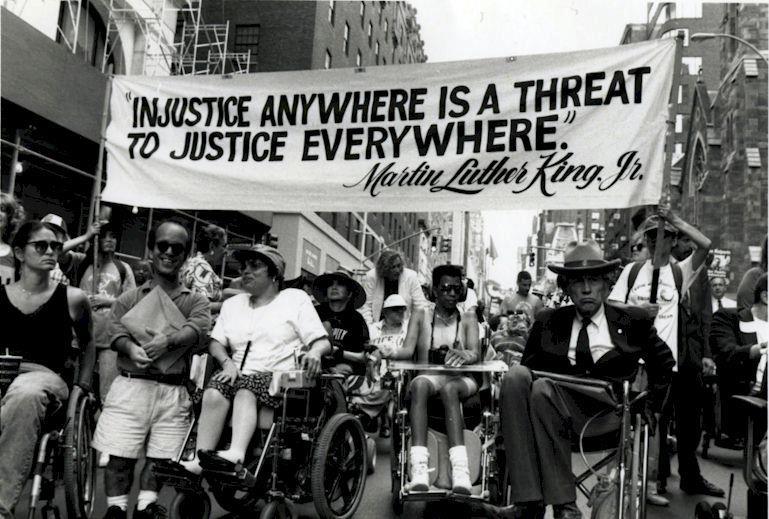
For MLK Day, this newsletter clipping about a speech I gave at Rev. King’s old church in Montgomery

Posted by – January 17, 2011

The University of Alabama
Alabama Disabilities Advocacy Program
School of Law Clinical Program

2003 Alabama Disability Summit

On August 14, 2003 the Alabama Disabilities Advocacy Program hosted its
third annual Disability Summit. Disability rights activists, advocates,
consumers, family members, and others gathered at the historic Dexter
Avenue King Memorial Baptist Church for a morning session that featured
Mr. Nick Dupree, Secretary of State Nancy Worley, Department of Mental
Health and Mental Retardation Commissioner Kathy Sawyer, and Governor
Bob Riley.

Mr. Dupree led off the session discussing the Supreme Court's Olmstead
v. L.C. decision in relation to Brown v. Board of Education, comparing
the racial desegregation of schools in Brown to desegregation of persons
with disabilities under Olmsted through deinstitutionalization and
community placement. Nick Dupree is a veteran disability rights activist
at the age of twenty-one. His efforts, along with ADAP, and “Nick's
Crusade" (www.nickscrusade.com) led to the development of a new
Technology Assistance Waiver approved by Medicaid in February 2003. This
waiver allows qualified Alabamians with disabilities over the age of
twenty-one to receive services at home, thereby limiting the need to
place these young adults in institutions.

Following Mr. Dupree, Secretary of State Nancy Worley addressed
accessible voting for persons with disabilities and Alabama. Secretary
Worley expressed her commitment to ensuring accessible voting and
explained the provisions of the recently enacted Help America Vote Act
(HAVA) that apply to persons with disabilities. Secretary Worley
encouraged people to contact her office (www.sos.state.al.us) with any
questions or comments about the new HAVA requirements.

Any problems with voting for persons with disabilities should be
reported to her office. Kathy Sawyer presented an overview of the Wyatt
Settlement. Commissioner Sawyer praised the progress the Department of
Mental Health and Mental Retardation has made under Wyatt. The
Commissioner also urged the audience to exercise their right to vote in
the upcoming tax referendum on September 9.

Gov. Riley concluded the morning session by outlining his proposed tax
package. The Governor emphasized that the package will both increase tax
revenue for the state and relieve the tax burden of those least able to
pay. Warning that misinformation about the tax package is being
circulated, Governor Riley asked voters to educate themselves about
details of the program. At the close of the Governor's address, ADAP
staff and guests marched from the Church to the State Capitol Building
for lunch and the afternoon session.
Share

The Cost of Denial For People with Disabilities

Posted by – September 25, 2010

To respond to the comments made during WBAI radio’s roundtable discussion about my latest blog essay “Why It’s Time For Survival Politics For People with Disabilities…”

The last statement in the radio segment about my blog was Josie Byzek saying that (my paraphrasing) the Tea Party may win big in the midterm elections, but then there could be a backlash at the ballots in two years (in the 2012 elections).
I don’t think the problem of inadequate services for people with disabilities will just go away with a political pendulum swing in two years. The dramatic changes that have already happened and will keep happening will ensure that these monkeys stay on our backs; because we squandered the budget for so many years on tax cuts and wars, budgetary realities will force severe benefit cuts, even if you had a 100% Dem Congress. No Congress will be able to govern in the way we’d all like, because of these very severe budgetary and political realities. Yes, part of the political reality is the Tea Party; those Tea Party activists and candidates who embrace an extreme form of Randism are more comfortable with disabled people’s blood on their hands than any political group has been in my lifetime; they’re completely comfortable demonizing people on public benefits as “robbers,” “leeches” and “parasites” and (I would argue) they’re completely irreconcilable with Judeo-Christian morality. Tea Party candidates and their Rand philosophy will be shaping the debate and helping define what is achievable legislatively like never before, and people with disabilities need to know about this, educate themselves, because this is a force that will affect our lives. But overlaying that is the larger problem of “we outta money.”

In this Dave Granlund cartoon, poor jobless people with a HELP sign reach out to Uncle Sam, but he just pulls out his empty pockets and says "I was going to ask you the same."

We’ll be paying the price for decades for the decision to try and pay for two simultaneous wars with tax cuts and “just go shopping!” and paying for it in numerous ways, some very painful. We gotta pay the piper, and we’ve run up a huuuuuuge tab. If history tells us anything, it’s that the tab is always borne by the poor and disabled, the most vulnerable and least able to pour money into campaigns to fight back.

Josie Byzek herself touched on the budgetary realities when mentioning sales tax revenue that helps fund state Medicaid isn’t the same anymore, the bottom fell out. We’ve got *apocalyptic* job loss, the last of the manufacturing sector exiting en masse, etc. Those hardhat-type 9-5 jobs won’t be coming back and you’d have to visit China to see them. The information tech world will be the source of jobs, but it hasn’t adapted and kept up enough to provide that yet, and it may be another lifetime before that happens. This will be a really ugly transition.

This Concord Coalition graph shows how Medicare, Medicaid and Social Security, in addition to interest on our enormous debt, continue to bloat the budget by % of GDP. In order to sustain benefit spending, we would need to HUGELY grow the economy, but currently, it's shrinking. Terrible choices are coming soon.

I’m arguing that technology, the economy, and politics are drastically shifting, and Medicare and Medicaid will soon change BIG TIME, so disability community leaders need to get in front of this and negotiate hard for the services we want to preserve most, because a lot of them ARE going away, and we have to get out of denial and start coping and adapting NOW! Catastrophic institutionalization, re-segregation, will happen unless we acknowledge that economic and budgetary realities mean that a lot of services are inevitably going away and negotiate hard for keeping select services we can’t go without (i.e. HCBS, Home and Community Based Services) using a cost-effectiveness argument. Congress won’t give a damn about us, but will care about cost if we make the case.

and y’know how Obama’s health reform bill increases Medicaid eligibility? It gives subsidies to help pay for the increased enrollment, but that enhanced FMAP is temporary. Then what? Then FAIL!! I’ve written about this in detail here; the eligibility mandates will hit the poorest states the hardest and they are already slashing programs to the bone to the extent they’re leaving us in our own waste. Once the eligibility mandates fully take effect in 2014, will the poorest states have to drop most care for people with disabilities? They could have to dump the people most in need, in favor of reshaping their programs to bring them in line with the new requirements, i.e. providing major medical coverage to low-income (able-bodied) adults. This is one of the worst parts of health “reform,” so very disconnected from the needs on the ground and the harsh realities we face.

This is a map of the worst and best Medicaid agencies in the U.S., with the reddest being the worst, and the lightest being the best. What I'm telling you is, this map will soon get much, much redder across the country.

In light of the situation, we need to be having conversations like “yes, we know that Medicaid dentistry and ophthalmology and free eyeglasses and prosthetics and leg braces and numerous things we’re accustomed to are going away, but we have to protect HCBS or the nursing facilities will cost the states EVEN MORE.”

We can’t afford the COST OF DENIAL. We can’t stay in denial that benefits will be changing; we can’t stay complacent! I’m saying WAKE UP, the societal, technological, economic and political changes are so great that benefits will be changing dramatically, and we aren’t prepared and we aren’t identifying priority areas to protect because there is an unwillingness to sacrifice ANYTHING, so Congress will likely cut EVERYTHING. Failure to get in front of this thing, staying in denial, will mean Congress will just impose 20% or 30% austerity across the board on all departments without understanding the issues involved.

Nick

Share

Nick’s Crusade Blog Featured On Local Radio WBAI!

Posted by – September 23, 2010

My blog posts are making waves! My new blog essay about the affect of the Tea Party and the related drastic benefit changes on people with disabilities was the subject of a roundtable discussion this morning on local WBAI radio’s disability chat show “The Largest Minority.”

You can listen to the radio discussion here.


Sept. 23 “The Largest Minority” on WBAI radio, featuring a reading of my blog essay “Why It’s Time For Survival Politics For People with Disabilities” and a roundtable discussion with cohosts T.K. Small & Lawrence Carter-Long, and guest Josie Byzek, New Mobility magazine

Listen to the discussion. I don’t agree that the shift in social services spending is a temporary problem that will be “all better” after the political pendulum swings back away from the Tea Party agenda.

I’m arguing that society, technology, the economy, and politics are drastically shifting, and Medicare and Medicaid will soon change BIG TIME, so disability community leaders need to get in front of this and negotiate hard for the services we want to preserve most, because a lot of them ARE going away, and we have to get out of denial and start coping and adapting NOW!

More on the important argument I’m making here: The Cost of Denial For People with Disabilities

Nick

Share

Why It’s Time For Survival Politics For People with Disabilities

Posted by – September 22, 2010

To listen to WBAI radio’s roundtable discussion about the below essay, go here.

This isn’t “The Great Recession,” it’s “The Great Change.” The recession–that is just a symptom of these enormous tectonic shifts going on (societally, technologically, economically, politically) and our inability to keep up has caused disruptions and economic downturn. That economic downturn is not the disorder, it’s just a symptom of the rapid changes spinning around us and our inability to cope. The change has come and will keep coming. Obama promised political change to help us adapt to all the other changes, but failed because of immediate backlash. Now, the backlash (led by the Tea Party) is bringing political change, and we’re headed for an upheaval that will radically shift ideas about the publicly-funded services and supports that keep people with disabilities alive and participating.

The Tea Party agenda is incredibly important for people with disabilities to learn about and understand because those ideas are here and will soon be back in the halls of power, BIG TIME.
Understand; the Tea Party movement is just the newest part of a self-described revolutionary movement that began in the ’60s with Ronald Reagan and first gained broad federal legislative power with the “Republican Revolution” brought by the 1994 midterm elections. The Republican Revolution brought us Newt Gingrich, Dick Armey, Tom DeLay, the leaders of the Revolution, and dozens and dozens of loyal soldiers under them. Those foot soldiers, Senators and Congressmen first empowered by the ’94 revolution, the “Revolutionary guard” if you will, make up the bulk of the Congressional GOP today. And they’re worried now because the Tea Party is leading a second revolution, and they want their seats. Rick Lazio is a good example. Lazio was yet another foot soldier for the Republican Revolution and its policy platform, the Contract with America (which demanded lower taxes, eliminating welfare, tougher anti-crime laws and a balanced budget amendment making deficits unconstitutional). That was no longer right-wing enough for conservative voters; Lazio got crushed by Tea Partier Carl Paladino in the GOP gubernatorial primary. You have to hate much more to be a real conservative. This is like one of Robespierre’s purges of earlier revolutionaries; it’s not enough to support the revolution and oppose the enemy, you have to show a frenzied enthusiasm for every facet of the revolution and consistently revile the enemy publicly, or face the guillotine. Paladino painted Lazio as a “liberal Republican” throughout the primary, an INSANE claim, and won because a huge plurality of Republicans actually believes this. Rick Lazio must feel like his head’s rolling down the palace rug right now, poor bastard. Republican Revolution of ’94 wasn’t enough; now, foaming ultra-conservatives demand Republican Revolution II!

Republican Revolution II has already started; they even use the language of revolution, openly. Example: from Carl Paladino’s victory speech: “The ruling class knows — they’ve seen it now — there’s a people’s revolution.”


Watch CBS News Videos Online
This video is a great primer on the Tea Party and what they’re all about.

This survey of the Tea Party shows that Tea Partiers are 89% white. Taken from the above CBS News video.

This survey of the Tea Party reveals that 58% of Tea Partiers keep guns in the home, and 63% (an overwhelming majority) get their political news from FOX News Channel. Taken from the above CBS News video.

Even if the GOP doesn’t take over the Senate and the House, the populist groundswell it has generated (and incumbents’ fear of losing their jobs) will severely limit what Congress can do.

What ideas are the Tea Party/Republican Revolution II based on?

Reaction. The primary idea/emotion of this movement is that Obama’s presidency and the Democratic Congress are threatening their way of life and they have to “take our country back.” Conservapedia, which often seems like a Colbert-penned parody but actually is a serious project founded by Andrew Schlafly (youngest son of early segregationist and anti-feminist leader Phyllis Schlafly), has a good article on the Tea Party movement and its founding motives, all of which are a reaction to Democrats and their policies. It really is akin to Italy’s Blackshirts; it’s an authoritarian mass movement (and is being studied as such by authoritarian psychology scholars). It fits the authoritarian blueprint to a tee, right down to the outcry of an oppressed “majority” against what they see as “radicals,” scapegoating (and fear-baiting) of minorities, fear of redistribution of wealth to the “lesser,” and rallying cries to return to a heralded, idealized past. They believe that if only Republicans (especially Tea Party-endorsed Republicans) controlled the government, the rapid changes affecting their lives and the economic anxieties and fear of losing privileges they cause would be reduced. Fear and rage animate this movement.

92% of Tea Partiers think Obama is turning America into a socialist state, according to this recent poll. Image taken from the above CBS News video.

Commentators online, including Michelle Malkin and Christopher Hitchens, have turned this AP Photo into the "Islamic Rage Boy" political meme that still floats around the blogosphere today.

It’s almost analogous to the infamous “Islamic Rage Boy” from Kashmir, in furious reaction to the Indian government that the protestors feel will eradicate their way of life. The Tea Party also sets up a battle for their way of life, absolute good vs. absolute, unadulterated evil, with no shades of gray in between.

The followers are reacting to economic anxieties, but the leaders are of an Ayn Randist-bent. If you’ve been an internet activist for over a decade, you could find them saying the same things they are now (staunch anti-federalism, strict constructionist view of the Constitution that damns all federal social programs as unconstitutional, blaming FDR and the New Deal for federal overreach and all subsequent economic problems, near-deification of Ronald Reagan, fundamentalist belief in Voodoo Economics to the point that they know that tax cuts can create enough new revenue to fund anything, white supremacy, extreme persecution complex, paranoid conspiracy theories about an all-controlling liberal elite) back in the Clinton and Bush years on web forums like FreeRepublic.com. Those wingnut views are now heard much more often as we allow the fringe to creep into the mainstream, but the hard-right ideas are not new. Online communities like FreeRepublic and their ilk would disgust most people in the first 20 minutes browsing threads; these are hard-right echo-chambers that have an incredibly radicalizing affect on their followers, environments where reviling “the other” is essential for being in the “in-crowd” and cross-pollination with known far-right extremist groups is vibrant and unconcealed. These guys have a hardcore agenda, and always sought to build a grassroots movement to primary out GOP incumbents and push the party to the fringe, but were never able to until the recession and widespread economic fear gave them a vehicle.

A neon green paper sign at the Tax Day Tea Party in Boston reads

What does the Tea Party mean for people with disabilities?

The Tea Party leaders’ Rand philosophy label us who use social services “robbers,” “leeches” and “parasites” because we suck up the wealth rightfully earned by the labors of others. Judging by this video of hate activists yelling abuse like “If you’re looking for a handout, you’re in the wrong part of town! Nothing for free here, you have to work for everything you get!” at a disabled man at a Tea Party rally, and throwing money at him in revulsion, this movement embraces Social Darwinism, and they really do intend hatred for us people with disabilities and cutting off our services. Though I too would like an end to UNNECESSARY government interventions (especially in the area of civil liberties, which conservatives seem to have abandoned en masse) what counts as necessary government intervention is where Rand-bots and I differ, because they see nearly every intervention as unwarranted tyrannical intrusion into private matters. For them, even saving people from dying of decubitus ulcers from lack of personal care is unwanted government overreach.

There are opponents of this extreme agenda within the conservative leadership, for example, the New York Conservative Party said: “If Carl Paladino wins this thing, it will cause severe damage — it could be for decades — to the Republican Party of New York State.” Many (correctly) predict an internal struggle over policy once the GOP wins Congress. If Tea Party candidates run the table, expect radical change in the services provided to us people with disabilities. More likely, incoming freshmen Congressmen will be unable to oust Leader John Boehner (R – Oompa Loompa) and compromises on policy goals are expected.

How should we adapt to survive drastic changes in social spending?

I call on disability community leaders to seek a meeting with future Speaker Boehner, as well as likely GOP budget planners Paul Ryan, Eric Cantor and Kevin McCarthy (who, during their book tour rolling out the 2010 Roadmap for America’s Future legislation, have been asking voters and fellow Congressmen for an adult conversation about how best to handle the coming scaledown in social services) and meet with them to discuss PRESERVING the most cost-effective services for people with disabilities: home and community based services (HCBS). If we people with disabilities have the needed home and community based services, we stay in our homes with our loved ones, producing value in our communities, paying sales taxes, property taxes, etc. But if those services are yanked out from under us, we end up in insanely expensive nursing facilities, or worse, dead. Conservatives are usually penny smart and pound foolish on this issue, slashing “optional” HCBS funding while leaving nursing home costs to continually balloon. That “institutional bias” has to change, or the affect on people with disabilities will be just devastating as political winds keep changing and funding streams dry up. The budget arithmetic just doesn’t work, so benefits have to scale down; stop thinking this won’t change, it IS changing!

Unless the disability community wakes up to the realities that Medicaid and Medicare will soon be drastically changing and we get IN FRONT OF the issue and begin educating and negotiating hard for our top 5 most essential services to preserve, our quality of life will go down the drain. Those of us in New York will be living with services like they have under Alabama Medicaid, and Alabamians with disabilities will fall to the level of Dominican Republic or Colombia or India. We have to prevent that. It’s time for hardcore SURVIVAL POLITICS!!

In Alabama, Medicaid policies really took a vicious turn after the first Republican Revolution took over Congress after the ’94 elections. Ideas about social services changed drastically overnight. In ’96-’97 I was fighting Alabama’s stated plan to end home nursing completely and ship every last one of us to institutions out-of-state. I won, but not before several people I knew died. After George W. Bush took over the presidency in 2001, Alabama Medicaid, began saying openly that they can’t afford home care and that it should be the responsibility of families and communities, not the state. Spending on home care dropped dramatically, to unprecedented lows. I had to lobby the state legislature, and eventually sue, to keep my care from being dropped when I turned 21. I won, and saved my younger brother, but my friend Chris died because no caregiver was at home to hear his disconnect alarm. Now with unprecedented yawning budget gaps, home and community based services are scant to non-existent in the red states. I escaped to New York just in the nick of time.

Please realize that the change is here already in most of the country, even California now–thanks to the Governator and a weak legislature. Too many in the NY disability community are happy, comfortable and complacent; ya’ll don’t see the tectonic shifts coming. It’s coming because of the growing consensus that we no longer want to pay for/can’t afford Medicaid and Medicare as it is now, the growing consensus for insane, rugged individualism. People with disabilities, WAKE UP! The time for soul-searching and tough negotiating with conservatives is NOW.

Listen to Paul Ryan talking about his “Roadmap.” Understand that soon we’ll have no choice but deep sacrifices and tough compromises, so the best approach is to negotiate hard for our biggest priorities, and start NOW!

Nick

Share

This Is All You Need To Know About This Year’s MDA Telethon

Posted by – September 6, 2010

Lots of people are, as always, posting about the MDA Telethon this Labor Day weekend (I recommend this piece by Laura Hershey). Usually the focus is on smashing the negative images (pity) that the MDA Telethon often conveys, and that is crucial because the Telethon brings to all corners of the U.S. the most-watched images of disability all year. But I usually focus on the help the MDA does and doesn’t provide, and how misleading the Telethon is about what they do for us “Jerry’s Kids.”

Jerry Lewis has taken a lot of heat for years over comments like “My kids cannot go into the workplace. There’s nothing they can do.” But I’m more concerned with WHY we can’t get into the workplace than with the negative comment itself. We stay at over double the general population’s unemployment rate not just because of “attitudinal barriers” (pity, seeing us as “less than,” and as charity cases, views the Telethon definitely perpetuates) but because we so often don’t have access to education, transportation, and the assistive technology that we need to succeed. Like wheelchairs.

The MDA sent out a letter to recipients last Fall, notifying us of major nationwide changes for fiscal year 2010: they will no longer help buy wheelchairs for “Jerry’s Kids.”

page 1 of scanned Letter from the MDA

page 2 of scanned Letter from the MDA
This scanned letter, passed to me by a concerned mom of kids with Duchenne’s, is not publicly available on the MDA web site, nor mentioned during the Telethon. I can only hope they don’t continue saying they provide wheelchairs on the Telethon.

The needs of those with MD are being met less and less by the MDA, and less and less by the state, cutting back brutally now thanks to the Great Recession. Now, future “Jerry’s Kids” will never again get a wheelchair with help from the MDA. Please look at these posts from the MDA forums about the changes, and MDA’s response.

I get no help whatsoever from the MDA, no matter how hard I have tried to work with them. The NYU MDA clinic essentially turned me away this year, the clinic director telling me “we don’t do metabolic disease” (nevermind that it was the Mobile, AL MDA clinic that diagnosed me with mitochondrial myopathy when I was a small child, and that their national goodwill ambassador Mattie Stepanek had it). Then, in a classy move, they referred me to a nonexistent “metabolic clinic” that when we called, said there is no such clinic. I’m totally open to discussion with MDA if they want to make this right, I would meet with an MDA representative if given the chance; but I’m not optimistic; their emphasis is simply NOT on those of us who’ve managed to survive into adulthood.

The charity model isn’t all bad; it can make a big difference in the lives of people with disabilities. Just look at the Islamic world, where people with disabilities often are getting more help (both physical and monetary) from their mosque than what we get from Medicaid! I got my first wheelchair from New Orleans MDA. But the MDA is really no longer a service charity, it’s research research research, cure cure cure, cures we’re told on the Telethon are only 5-10 years away but 20 years later are nowhere to be found.

A real charitable organization could make a huge difference in our lives, filling the enormous gaps we fall into every day, an understanding voice that could give hope for better quality of life after yet another Medicaid rejection of services. These diseases are no easy path. I REALLY NEED THE HELP! Just a shoulder to lean on and a little coordination would go a long way. But MDA is not that charitable organization, and it takes up so much “market space,” no competing nonprofit can gain the traction to provide this desperately needed assistance. That is my beef with the MDA, and I wish the discussion among disability rights circles was more in this direction.

Nick

See also, my blog about last year’s Telethon, focusing on dismantling misleading claims made on the Telethon.

Share

2 years

Posted by – August 28, 2010

August 28, 2008

The end of the beginning of the journey (Nick arrives at Coler-Goldwater Hospital in NYC from Mobile, via Atlanta and LGA).
Share

Feds Fiddling While State Medicaid Programs BURN

Posted by – May 21, 2010

Question: In light of Obama’s plan to expand Medicaid eligibility, is anyone in Congress noticing the MASSIVE state budget cuts to Medicaid across the country and ruminating about how that jives with this impending expansion? I fear that if states have to raise income eligibility and bring millions of uninsured onto the Medicaid rolls, that will mean even deeper cuts in “optional” home care programs to pay for the expansion, and even more people with disabilities’ dreams shattered.

I wish Congress would have put protecting the most disabled Americans ahead of uninsured able-bodied people, but they didn’t. For Congress, people like me are invisible.

The states slashing Medicaid the deepest (the Southern states) are the ones that will see the most new Medicaid eligibles thanks to “Health Care Reform.”

PERFECT
FISCAL
STORM

That means life for people with disabilities in the South is about to get even worse. Good thing I fled Alabama.

Medicaid, especially in the South, is increasingly in tatters. State Medicaid programs were slashed to the bone in the 90s thanks to “the Republican Revolution” and now there’s no fat left to trim, so they’re taking chainsaws to muscle and bone.

In the Wall Street Journal, it discusses a woman who’s had to sit in her own waste all day thanks to state budget cuts. I suppose the state hoped her bed sores and inevitable sepsis take her quickly, otherwise Medicaid will be on the hook for expensive hospital stays that would dwarf the cost of just leaving her f#$%ing home care uncut in the first place. I’ve seen this happen over and over again to people I fight for. It’s left me scarred to depths few of you could ever understand.

Here’s the Wall Street Journal piece, by Clare Ansberry.

FLORENCE, S.C—Tandem forces of shrinking state budgets and rising health-care costs have collided and struck a small brick ranch house in this rural town, home to Barbara Hickey.

Born with cerebral palsy, Ms. Hickey, now 67 years old, is confined to a motorized wheelchair. She lives alone and relies on certified nurse’s assistants to get her in and out of bed, bathed, clothed and fed.

In December, she received a letter from the South Carolina Department of Special Needs and Disabilities, saying her weekly 50 hours of personal-care help was being cut to 28 hours. That meant Ms. Hickey would get help for two hours in the morning and two hours at night. If she needed to use the bathroom in between, she would sit in a soiled diaper.

After several days of reduced care, the local office of the South Carolina Legal Services appealed the cuts on behalf of Ms. Hickey. Her hours have been restored pending the appeal.

Home health care—funded largely by Medicaid—generally costs less money than institutionalizing developmentally disabled people like Ms. Hickey. But the political reality is that it’s easier to cut back home services than to close a 24-hour facility, which can leave people with nowhere to go. Thus, some of the biggest cuts around the country are happening in the basic services that help the disabled cope at home.

South Carolina says it has little choice but to cut funding for Medicaid. It faced a $563 million deficit for the current fiscal year, and like other states must have a balanced budget. Medicaid, the joint federal-state health-insurance program for the poor and disabled, already consumes about 20% of its $5 billion budget and is one of its fastest growing costs.

The health-care program is on course to consume 40% of the budget of South Carolina in five years, and leaves little for anything else, says Gov. Mark Sanford. “It could force legislators to either cut further into bone in the areas of education, law enforcement and economic development, or raise taxes. Neither option is palatable.”

The state already is making painful cuts elsewhere. The state’s Department of Juvenile Justice has closed five group homes and cut 25 after-school programs. There are 1,000 fewer public-education teachers this school year than last.

Across the country, budget-strapped states are focusing on Medicaid. Created in 1965, it is now a $379 billion program, including state and federal funds. State spending grew an average 7.9% in fiscal 2009 as the economic crisis hit and more people signed up for Medicaid.

It was the highest growth rate since the last downturn six years ago. Spending is expected to keep growing at that pace for the next decade because of rising costs and growing enrollment.

But states don’t have much flexibility when it comes to what they can and can’t cut inside Medicaid. Although it is a state-managed system, the federal government pays a percentage of each state’s total costs and makes many of the Medicaid rules. Under federal Medicaid law, states must offer inpatient and outpatient hospital care, X-rays and lab services. They also have to cover nursing-home services and meet certain standards, such as staffing ratios.

There are further constraints this year. States can’t reduce Medicaid eligibility this year because of a condition attached to federal stimulus money, and under health-care reform, they can’t eliminate existing programs.

States also run up against other laws when they make deep cuts. Lawsuits have been filed in South Carolina, Florida, Connecticut, Virginia, Mississippi and New York, claiming Medicaid cuts make it impossible for those with disabilities to live at home and that it violates the Americans with Disabilities Act.
(I know the lawyers behind this class action. I say RIGHT ON!!!!)

Logically, states would cut the most expensive, least efficient services and keep the most cost-effective. But because of mandates and the need to save money quickly, that isn’t as easy as it sounds.

For example, home care—because relatives often provide some of the care—is generally cheaper than housing people with developmental disabilities in institutional facilities. In 1993, the average Medicaid cost for each person with disabilities was $48,500. At the end of 2008, the latest figures available, it cost an average $55,000. Adjusted for inflation, that actually represents a 23% decrease, largely as a result of more services being shifted away from costly institutions to the home, says Charlie Lakin, director of a University of Minnesota program that tracks services for the developmentally disabled.

But many in-home services, though critical to those receiving them, are optional. Furthermore, there aren’t many minimum standards set for in-home services, so it’s easier to cut them without violating funding requirements. There are fewer immediate consequences for the state when it cuts those services because families won’t generally abandon disabled relatives and leave states on the hook for housing.

Cutting home care could ultimately prove penny-wise and pound-foolish, however. It could push more people into institutions or large group homes because that is where services are guaranteed, even though institutional care is more expensive.

The department’s fiscal problems have been exacerbated by past spending decisions. A special state audit released in December 2008 showed that the department hadn’t provided many new services for which it had received funding and, as a result, it couldn’t recoup millions in federal matching Medicaid dollars. For example, the state spent less than $700,000 of $10 million allocated to serve autistic children, which resulted in the loss of $13.6 million in federal matching money. The state said it couldn’t ramp up the program fast enough because it couldn’t find qualified service providers. After the audit, the executive director of the department and four of the department’s seven commissioners resigned. The department has since implemented most of the recommendations made by the Legislative Audit Council.
(This same thing nearly happened with the NHTD –Nursing Home Transition & Diversion– waiver here in New York: the bureaucracy imposed on providers was SO ridiculous than very few participated, and the rules were so cumbersome for patients that, in the program’s first two years, only one patient downstate–me–transitioned home from a facility!)

Recent state cuts have targeted developmentally disabled people living at home. In December, families were told that some of their in-home support was being cut by as much as half.

Brian Phillips, a 37-year-old with cerebral palsy, was told that he was losing half of his personal-care hours. He can work a TV with a remote control but can’t dress or feed himself, or get in and out of his bed or wheelchair.

He lives alone with his father, James, 70. The elder Mr. Phillips, who has had open heart surgery and whose heart functions at only 26% of its capacity, cannot lift Brian on his own. He appealed the cuts and the hours were restored pending his appeal.

“These are cuts no one wants to make. They are very difficult for agencies to implement and they are very upsetting and very, very difficult for our families,” says Lois Park Mole, spokesperson for the state Department of Disabilities and Special Needs.

People will generally do what they must to keep their disabled family member at home regardless of the cuts. At some point, however, even the most dedicated may not be able to continue, especially as their own health deteriorates.

In Aiken County, Board of Disabilities Executive Director Ralph Courtney says waiting lists for services are growing. There are more than 5,000 on waiting lists for various services, from residential programs to in-home programs.

“We want to give families hope to keep their family unit together, but in reality there is very little we can put in place to assist them,” says Mr. Courtney.

In-home support is cheaper, he says, than the alternative: group homes and larger residential programs that need to be maintained and staffed 24 hours a day. “But you can’t put people out on the street,” he says. “You can cut in-home support.”

Even though Ms. Hickey lives alone and needs help with nearly every aspect of daily living, it cost less to have her live in a house with 50 hours of personal care help than in a nursing home. Institutional care in South Carolina costs about $100,000 per person a year, compared to $39,000 for home and community services, according to the University of Minnesota research.

Read the entire article here: Disabled Face Hard Choices as States Slash Medicaid

How does littering the entire country with families destroyed by Medicaid cuts, jive with HEALTH CARE REFORM?

Honestly, I have gotten so many hate messages over the years, I’m now convinced that the Americans will continue to react with cold indifference, or, worse, celebration–”good riddance! No one is gonna force me to pay for you useless leeches!”–as Medicaid policy continues to cull out people with disabilities like me, UNABATED.

And you wonder why I’m so angry that I’d consider reconstructing the U.S. entirely? It’s because my every day experience involves the above Kafkaesque Medicaid policies harming me or the people I care about!

Nick

Share

Nick’s Essay on America’s Decline, with Big Solutions (long)

Posted by – May 15, 2010

I’ve been away for quite some time, I know, but I haven’t stopped thinking about public policy and the way things are going.

They aren’t going well. I followed the health care reform debate with a magnifying glass throughout, and came away deeply disgusted in both the final product and the process that made that sausage.

We desperately needed SERIOUS reform to the United States’ health care non-”system”; we’re in the richest country on Earth, but among OECD nations, our health care is at the back of the pack. No country with our level of wealth has our level of dysfunction in basic health care.

Instead of “the change we need,” what we got when Congress was done kowtowing to big insurance donors and passed the damn thing, was incremental change to half the health care industry (the private insurance market) while leaving the half the government actually runs, Medicaid and Medicare, nearly untouched. The goal of the Obama reforms is to give more Americans access to the health insurance market, more people buying insurance, with subsidies to help the poor afford private insurance. The health insurance industry stands to rake in BILLIONS! I was devastated with disappointment.

Meanwhile, the frenzy on the right wing about this bill (which was nearly a straight copy and paste of the 1993 Republican health care bill (full text of that bill, see for yourself) taking us to “socialism” are patently absurd! I’m like “really? The first thing communists do when they take over a country is enact tepid, insurer-friendly reforms that set up a free market exchange so more people can buy insurance plans? Seriously?” A volcano of right-wing rage exploded, including dozens of death threats and some vandalism across the country. How can anyone take the Tea Partiers and Glenn Beck seriously that health care reform is anything but weak-kneed incrementalism?

The Tea Party is more disconnected from reality than any political movement I’ve ever seen, and yet, they seem to be the only major grassroots force out there and their impact is unavoidable. They’re protesting more private insurance as socialism, railing against the lowest income taxes since the 1920s as communist tyranny (simultaneously, the largely graying group opposes changes in entitlements–”get the government out of my Medicare”) and now that they’re doing the one thing that Republican politicians really care about, picking off incumbents, you’re going to see the GOP tilt even more toward the radical fringe (a terrifying prospect).

Real sign, real Tea Partiers. Medicare is a government-run program.

Since the Tea Party guys’ claims have little relationship to reality, and none of them took to the streets when George W. Bush took us from record surpluses to record deficits, centralized power and forever gutted the Bill of Rights in the name of the War on Terra, the Tea Party has to be about something else. You never see the huge, angry backlash and anti-government “patriots” in funny hats and militia terrorists like McVeigh come out of the woodwork when THEIR party is in power! I’m guessing the root of the dispute here is the right-wing’s belief that government shouldn’t have the right to interfere in the market AT ALL, and add in some good ol’ American racial panic when the multicultural Democratic party took over from the virtually whites-only Republicans. Expect another McVeigh-style attack before Obama leaves office (there have already been several shooting rampages, including one targeting religious liberals at a Unitarian church, one targeting policemen for “gonna take our guns,” and one by a long-time rightist fringer targeting Jews at the National Holocaust Museum in DC).

All that furor against the health care reform bill, while, of course, from the disability rights perspective, Obama’s reforms don’t go nearly far enough, because they only make meaningful changes in private insurance, not Medicaid and Medicare, which most of us with disabilities rely on for our care.

Medicaid and Medicare are BADLY broken and rapidly going bankrupt, but aside from expanding eligibility so that more people will be crowding already scant Medicaid resources, nearly NO changes are being made there. The home care reforms I’ve devoted a decade to are not in the bill; America’s long-term care programs remain frozen in 1965, with government continually making expensive, antiquated segregation in nursing homes THE ONLY OPTION for the disabled, including children and young adults. The horribly dysfunctional patchwork of Medicaid waivers that I rail against? Despite years of demands for change from many quarters, including the National Governors Association, those injustices will remain firmly intact, untouched by “comprehensive health care reform.” People like me will continue struggling to wring bad care from what’s left of Medicare and Medicaid; our lot will not improve at all after “Health Care Reform” takes effect. I am fighting this battle every day, and the problems with hospitals closing due to inadequate payments from Medicaid, not being able to find doctors who still take Medicaid patients, and more, just continue to escalate for me.
Meanwhile, the insular Washington leadership is curiously detached and unaware of what’s happening to their own Medicaid and Medicare programs right under their noses. President Obama made me sick when, during the health care reform “summit,” Congressman Peter Roskam (R – Illinois’ 6th district) asked him, “how can we expand Medicaid when in some counties, NO doctors that take Medicaid are left standing?” and the gist of Obama’s response was “my word, what is this that you speak of my good fellow? if this is so, we can look at raising reimbursement rates!” Everyone knows that they’ll never hike Medicaid funding, and that’s why so many in Congress sought special provisions in the bill (e.g. “The Cornhusker Kickback”) for the feds to cover their states’ new unfunded mandates to expand eligibility to millions of additional people. These expansions are not going to go well, particularly in poorer states, especially since the “kickbacks” to soften the fiscal blow were all removed from the bill with reconciliation.

The failure to even attempt changing the glaring problems with Medicaid and Medicare has left me more jaded and frustrated than ever, to the point [b]I can no longer call myself a Democrat[/b]. Especially since I know that Congress exhausted itself scraping through this tinkering with private insurance, and most likely won’t have the political will or sense of urgency to revisit health care issues for another 10, 20 years. I hate being stuck with our dysfunctional Medicaid system but that’s what people with disabilities are, stuck.

While some pundits hailed the passage of health care as a colossal foreign policy victory, proving America can tackle huge issues, marking our “comeback” as problem-solver on the world stage, I see the opposite. I see a government that lacks the dynamic, bold decision-making capability that these ultra-competitive times demand, a Congress that always cops out or kicks the can down the road in the face of huge problems. I see an America so paralyzed by corruption and red tape that we’ll never catch up with competitors (people in India have already stuck a fork in the U.S., considering the Chinese their only real rival for economic dominance at this point).
Referring to China, I’ve often heard President Obama use the rallying cry, “why can’t we be the world leader in technology again?! Why can’t we have the fastest trains in the world?” Well Mr. President, I would answer him, we will never build trains and train tracks faster than China, because we have so much “environmental impact study” and “archeological impact study” red tape, followed by years of hearing lawsuits from anyone who doesn’t like the project, that it takes an average of 10 years to get any major transportation project off the ground, much less completed. China, meanwhile, simply makes a decision on future train projects, then enforces it by any means necessary. How can we compete with that given our bureaucracy?

While those panicked about executive power right now can take a sigh of relief, because presently it seems Obama can’t even take a $#!T without 60 votes from the Senate, I worry that, before long, fierce foreign competition, falling standards of living, plus a completely paralyzed Congress will lead the American people to demand a dictatorship. Another sudden economic crash, or, G-d forbid, successful terrorist attacks (by Islamist nutbags or another McVeigh) and I fear that the Republic will gasp its last gasp.

The only real solutions are solutions as big as the problems, pushed through by reform groups that aren’t just as dysfunctional as the institutions they’re fighting.

Big Solution #1: Ban campaign contributions (bribing) to public officials, as this has limited access to the halls of power ONLY to moneyed interests, as well as fostering a culture where those who spend more time working for the people than working on fundraising are immediately replaced by candidates with backing from deep-pockets, leaving only self-interested scoundrels remaining. Free speech must be immutable, overturn all McCain-Feingold restrictions on when and where and how candidates can advertise and get their message out, independent expenditures by corporations, unions, advocacy groups and private citizens are unfettered, you can say whatever you want, whenever you want with your free speech, because that’s what the 1st Amendment guarantees–you’re just not allowed to bribe public officials with campaign contributions and rig the system. Campaigns will be publicly financed like in Canada, the UK, and most of Europe. Speech is speech. MONEY IS NOT SPEECH!

Big Solution #2: Breaking the Duopoly is crucial, but WILL NOT happen without a change in the Constitution to allow Proportional Representation via STV (“Instant Runoff Voting,” AKA Single Transferable Vote, as is done in Australia, New Zealand, Republic of Ireland) to bring more parties into Congress. Allowing more parties will enable more principled views to be expressed (because, for example, if you want less intrusive government and less taxation, you won’t have to vote Republican for the tax cuts and get warrantless surveillance, anti-gay crap and anti-immigration laws too as part of the package, instead, you can vote for a party that closely matches your views). More parties also mean regional parties representing genuine regional people’s interests get into the mix. And parties would have to work together to coalesce into viable majority coalitions, and would have to curb the extremist nonsense to keep their coalitions together. Overall, Proportional Representation allows for a much, much healthier democracy, whereas currently we have the opposite of healthy democracy, the Duopoly nearly always wins 100% control of the House and Senate with the support of as little as 20-25% of eligible voters, at the cost of all other parties and their viewpoints.

Big Solution #3: This is my most radical view, but failing Solution #2, maybe we could be far more functional as a people and be much better represented, plus have no more imperialist ventures sapping our wealth, if we were to make a new version of the old Articles of Confederation for the new Information Age that separates the country into 6 or so federated regional powers (see: superstates) to avert any FURTHER deadlock, dysfunction, or civil war (each new state under parts of the current Constitution they elect to have, but empowered to each craft very different rules, based on their shared culture, for how society should work). I’m talking about ending the United States as we know it, replacing it with a federation of nearly autonomous federated republics named “the United Federation of America” (UFA! UFA! UFA!) Each federated republic would choose their own military spending and so on. Think of The Federation (United Federation of Planets) in Star Trek! That’s the type of idea I’m batting around here.

Click to enlarge the map!! In this vision of the future, South Carolina even secedes from the Southern Republic, because, hey, they've wanted to secede since birth.

I’m going even farther than “states’ rights.” I’m altering how the country operates–root and stem overhaul–by almost completely eliminating federal centralization as we know it. Why go this far? Because the paralysis of government has become so bad over the past 30 years that we have to consider crazy, radical ideas we would have shunned in disgust before.
Southern culture should never block Northeasterners’ ambitions for reform in New York where I live now, and visa versa. I moved to NY in large part to escape Alabama’s far-right public policy that was blocking my advancement, but while it’s better here, those policies (tax cuts causing huge deficits, social service cuts, the corporatist approach that keeps the institutional bias in Medicaid alive) FOLLOWED ME to New York because they’re federal policies too. And I believe the policies that affect me would be very different if only a Northeastern bloc could decide their own policies, vs. a national consensus accommodating Southern, Western, everyone’s views being forced on the Northeastern states. National compromises should no more be forced on the Northeastern states than on the Southern states (with some exceptions: states can’t disregard the certain parts of the current Constitution, like reinstating slavery or segregation).

This won’t happen any time soon (there is no public support for it) but maybe we’d all be better off if it did…

I just know that the only real solutions here are solutions as big as the problems. Without trying at least one of these big solutions, get ready to shout “HAIL CAESAR” and go full Banana Republic, while China becomes undisputed world hegemon.

Nick

Related Posts with Thumbnails
Share